
The GitHub Copilot Fusion Price Is Not the Name You Clicked
A name in the Copilot model picker is not a price and not a default: cap one Fusion session at Standard and grade the answer from the test file.

A picker name is not a price and not a default. Cap one session, stay on Standard, and let the test file grade the answer.
You opened the model picker, chose the name that looked strongest, and still could not say what the turn would cost. The name was never a price, and the only number that protects this session is the credit cap you type yourself.
In this article: You will start one GitHub Copilot CLI session under a credit cap you choose, select Copilot Fusion at Standard effort, and ask one question whose pass condition is a test file. You will see why a picker name is not the GitHub Copilot Fusion cost and not a default, how Fusion bills the models it uses, and what the plans included on November 16, 2026. By the end, the usage page is open, the tree is clean, and a session cap is distinct from a billing-cycle budget.
Preview: written November 16, 2026, before Microsoft Ignite. Some paid steps are not yet tested live; this guide will be updated November 21, 2026.
The model picker looks like a price list. The highlighted name looks like the one to pin. Neither reading is true. A name in the picker is not the GitHub Copilot Fusion cost, and this article will not teach a default model.
GitHub Copilot Fusion is a router, not one model. You select it in the picker. The router then chooses among models for that request. Fusion bills each model it uses at that model's standard rate. There is no separate Fusion charge, no monthly Fusion add-on, no Fusion CLI flag, and no Fusion discount. The number that bounds this turn is a session credit cap you type yourself. One AI credit is $0.01, as of November 16, 2026.
The walkthrough uses Ticket Triage at ~/code/ticket-triage. You confirm a clean tree and four passing tests, start Copilot CLI with --max-ai-credits and a small number you choose, select Copilot Fusion at Standard, and ask one short question. The test file grades the reply. You do not commit. This Fusion turn was not executed on November 16, 2026. There is no transcript. Re-run it on your account before you trust the wording of any reply.
Starting fresh or fell behind? Run git switch -C main copilot/day-05. This replaces your main with the end of Day 5; to keep your own work, run git branch my-backup first.
Confirm the tree before you spend
These steps use Copilot CLI 1.0.112, as of November 16, 2026. Another 1.0.x line is acceptable when you write it down. If the line is not 1.0, stop. Do not reinstall.
copilot --version
Write the line down if you did not keep it. The model picker is the on-screen control that lists the route and the effort. The file check below does not depend on those labels.
The crushed-mug test is already in test/classify.test.js. src/classify.js is unchanged. Four tests pass. The tree is clean. Record that before the session, so a later empty status means the session added nothing.
cd ~/code/ticket-triage
git status --short
git log -1 --oneline
git diff -- src/classify.js
npm test
git status --short prints nothing. git log -1 --oneline prints one line. Copy that line. After the session it must be the same line, which is how you know you did not commit. git diff -- src/classify.js prints nothing.
npm test reports four names: refund, shipping, other, and crushed mug in pieces is other, plus # tests 4, # pass 4, and # fail 0. Timings do not count.
If status prints paths, stop. Do not ask the agent to clean them, and do not commit. If the classifier diff prints a patch, stop. Do not start on a dirty src/classify.js. If the pass count is not four with zero failures, stop. Do not edit the classifier to force the count.
Open test/classify.test.js and find the last test. You are checking the file you already have. You are not pasting a new test.
test("crushed mug in pieces is other", () =>
  assert.equal(
    classify("The box showed up crushed and the mug inside is in pieces"),
    "other"
  ))
The name is crushed mug in pieces is other. The sentence is the crushed-mug ticket. The expected value is other. If your file does not contain that text, stop. Do not ask a session to rewrite the test so a later reply looks right.
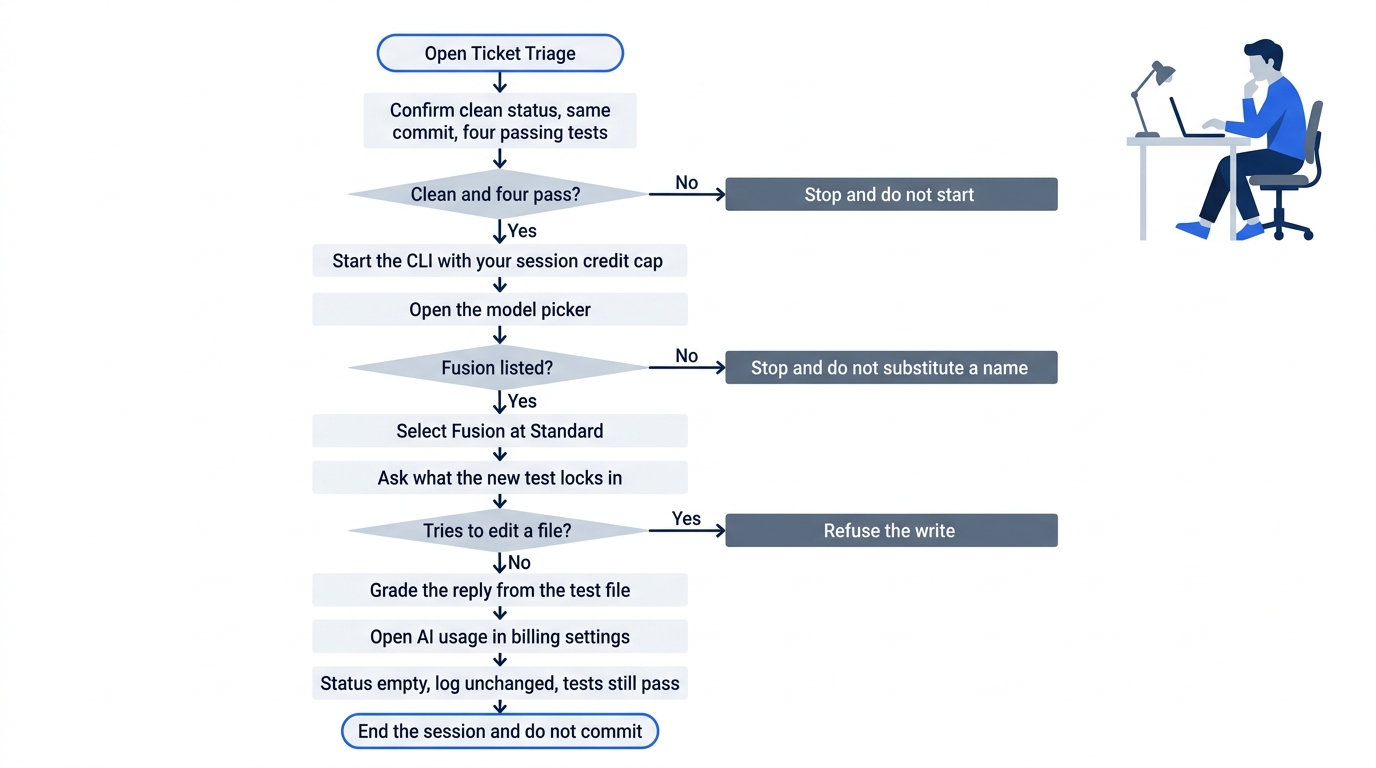
You start only when status is empty, the commit line is copied, and four tests pass. You cap the session, select Fusion at Standard if it is listed, ask one question, and refuse any write. A dirty tree, a missing Fusion entry, or an edit attempt ends the exercise. The last proof is an empty status, the same commit line, and the same four passes.
One cent, and a cap for this session only
An AI credit is the unit GitHub uses for this usage. One AI credit is $0.01, as of November 16, 2026. The definition is on the individual billing page. You do not turn that cent into a monthly plan here. You only need the unit so the next flag has a meaning.
--max-ai-credits sets a ceiling on the credits this session may use. The ceiling is this session, not the account, and not the user-level budget on the billing page. A user-level budget is the hard stop for the billing cycle. This flag does not type that budget, and that budget does not type this flag.
The command shows 20 so you can see where the number goes. The 20 in copilot --max-ai-credits 20 is a placeholder session cap. It is not a day-1 budget, and it is not a price. Replace 20 with a small number you choose before you press Enter. The number in the fence is not a recommendation for your account.
cd ~/code/ticket-triage
copilot --max-ai-credits 20
You replace 20, and you pass no other flag. You do not pass a model name. You do not pass a flag that selects Fusion. The November 16, 2026 notes do not give a Fusion launch flag. --max-ai-credits is the only extra flag. You do not pass --yolo, --allow-all, or --allow-all-tools. You do not resume an older session in place of this command. A session you started earlier does not carry this cap. On Windows, use the same command from the Ticket Triage folder you have been using.
If the shell history later shows the placeholder 20 and you meant a different number, the check fails until the history line shows the number you chose.
Fusion at Standard, and no model name
When the session is ready, open the model picker. These steps do not name a keystroke or a slash command for it. If the only way forward is to type a model name on the command line, stop. End the session. Do not type one.
Fusion reached general availability on October 28, 2026. The announcement is Route and orchestrate models with GitHub Copilot Fusion. In the picker, choose Copilot Fusion. Then set the effort. Effort is how hard that router works on the request. Standard is the everyday-efficiency effort. High and Max are higher efforts, and they can spend more. You use Standard only. You do not select High. You do not select Max.
If the picker shows model names, you do not write one down as "the" model. You do not put one in an instruction file. You do not add one to the command and start over. Names in a picker can change. Your note says Copilot Fusion and Standard. It names no model.
If Copilot Fusion is not listed, stop. Do not substitute a highlighted name. End the session without the question. You can still open the usage page later. You cannot record Fusion as selected if you picked something else.
Gotcha: the miss is copying a picker name into your notes and calling it the model this article uses. The pass is Fusion plus Standard, with no model name beside them.
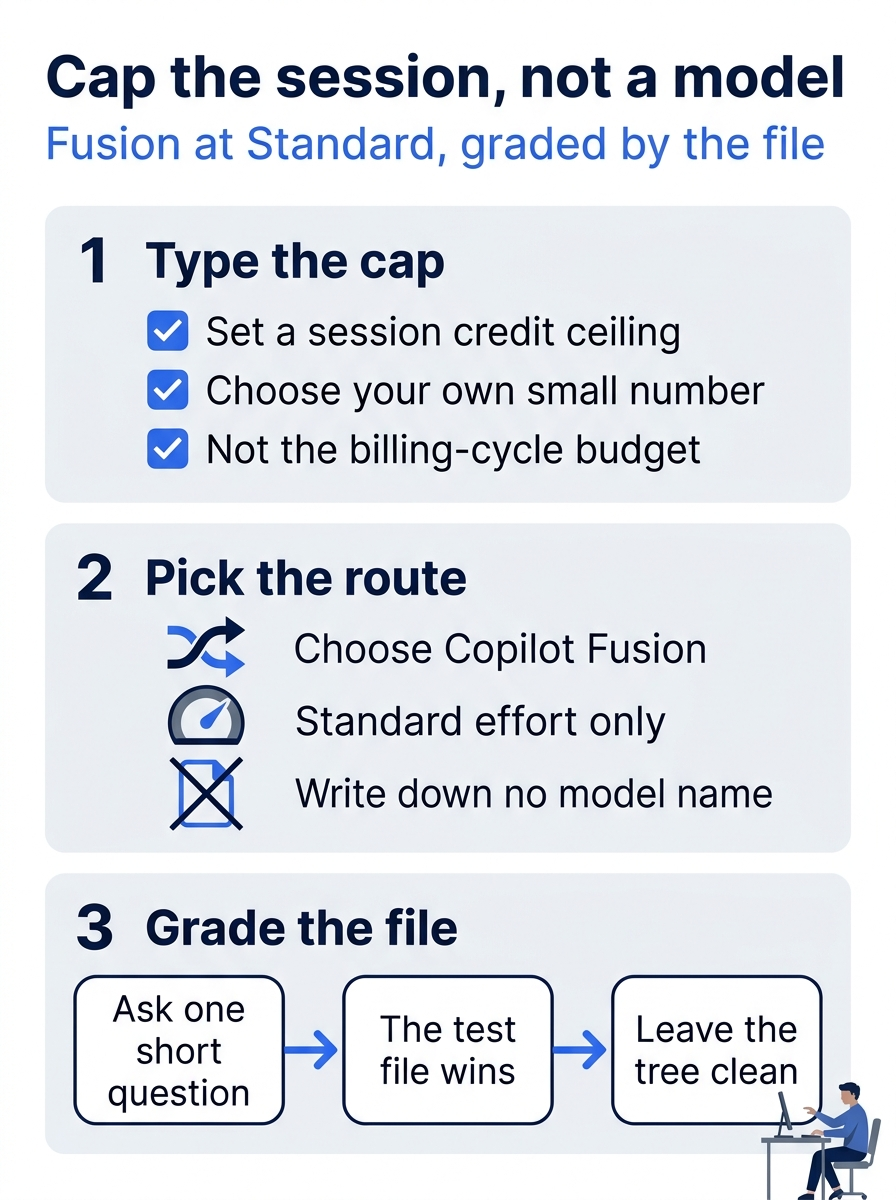
The habit is three checks, not a favorite model. You type a session credit ceiling and choose the number yourself. The number you type is not the billing-cycle budget, not a day-1 budget, and not a price. You choose Copilot Fusion at Standard and write down no model name. You ask one short question, let the test file win, and leave the tree clean.
One question, graded by the test file
After you select Fusion and Standard, you ask one short question. You do not add a second sentence that asks for a code change. You do not approve an edit, a commit, or a push. The session can read the project's instruction files. They do not grade this question. The test file does.
What does the new test lock in?
Wait for the reply or for a permission question. There is no sample reply. This Fusion turn was not executed on November 16, 2026. Re-run this on your account before you trust the wording. The reply's wording is not the check.
You check the file yourself. The human answer, which you write only after you read the file, is this: crushed mug in pieces is other keeps the crushed-mug sentence returning other, and src/classify.js is unchanged. If the reply says something else, the file still wins. You do not edit the file to match the reply. You do not paste the reply into the test.
If the turn tries to change src/classify.js, test/classify.test.js, or any other path, stop it. Do not approve the write. A helpful rewrite of the classifier is a failed check even when the prose sounds right.
End the session after that one question. Do not ask a second question about the bill. Do not ask the session to commit a note about the answer.
The usage page, then the proof
Open the AI usage page. On GitHub, open billing settings, then AI usage. The Copilot Billing Preview app retired on August 4, 2026. Leave any bookmark that still opens that old app.
Find this session if the page shows it yet. Usage can lag. A missing row does not mean the cap flag failed. The win is that the usage page is open, and that --max-ai-credits is present in the command you ran, with your number. You do not need a dollar figure on the row. You do not keep refreshing until a number appears and then call that the only pass. If the row is missing, write "usage page open, session not listed yet."
You do not change the user-level budget while you are on the page. You do not turn on a wider spend limit because the row looks small.
These commands are yours. The reply is not the proof.
git status --short
git log -1 --oneline
git diff -- src/classify.js
git diff -- test/classify.test.js
npm test
git status --short prints nothing. git log -1 --oneline prints the same line you copied. Both diffs print nothing. npm test still shows the four names, # tests 4, # pass 4, and # fail 0. You did not commit.
If status prints paths, the check failed. Do not commit those paths. If the log line changed, a commit happened. The check failed. Do not push, and do not rewrite history to hide it.

Relief is an empty status and an untouched test. The session was allowed to answer. It was not allowed to tidy the repository into a different story. The flowchart on the monitor is the path you just walked: a cap you chose, Fusion at Standard, one question, then proof from your own shell.
You can stop here. The rest is the GitHub Copilot Fusion cost behind that cap: how the router spends, what a plan included on November 16, 2026, and why a highlighted name is still not a default.
Three ways Fusion spends, and no flat fee
Fusion charges through the models and tokens it actually uses. A pattern is a way of spending that work. It is not a menu price.
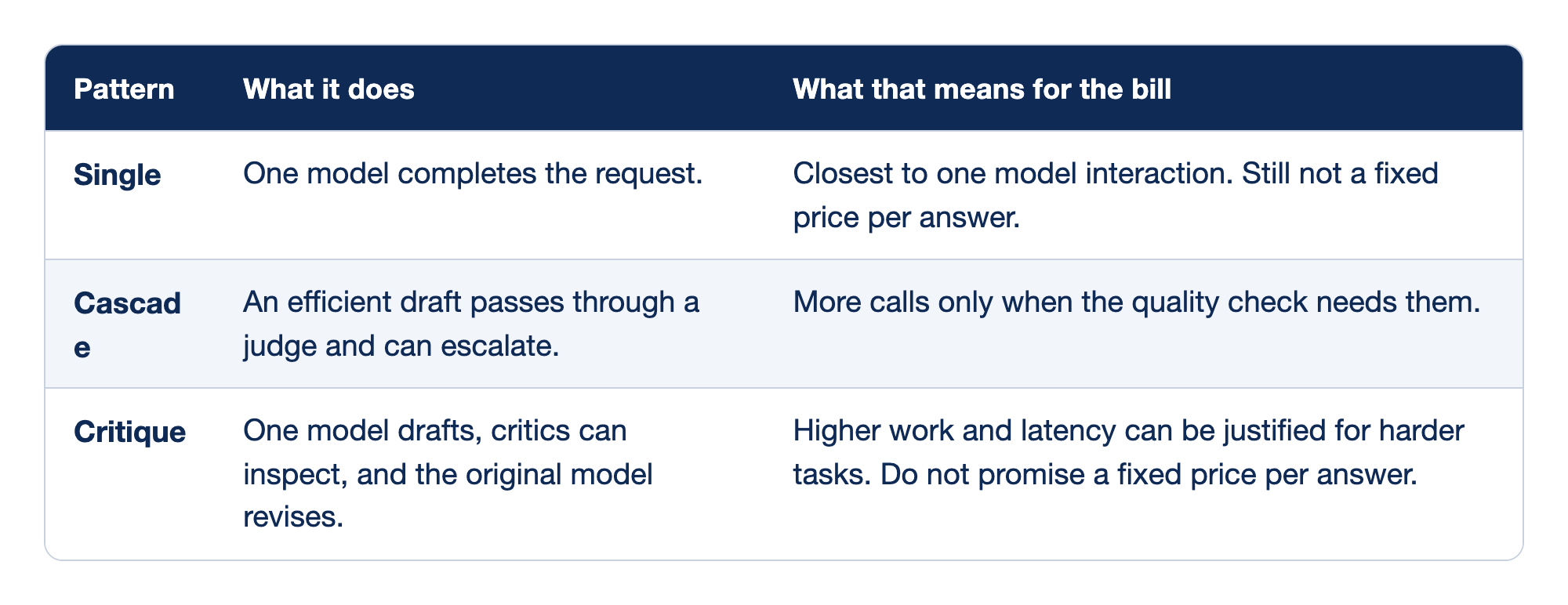
Three Fusion patterns name a way of spending model work, not a menu price. Pattern is the spending shape. What it does is the sequence of calls. What that means for the bill is the cost idea that goes with that shape, and none of the three is a flat fee. You did not record which pattern ran for the Ticket Triage question, because this Fusion turn was not executed on November 16, 2026. You do not guess a row and write it down as what happened.
- Single means one model completes the request. The bill is the closest of the three to a single model interaction, and closest is not flat. Tokens still vary, and this article does not price the sentence you asked.
- Cascade means an efficient draft passes through a judge and can escalate. Extra calls happen when the quality check needs them. You do not treat Cascade as free because the first draft was short, and you do not treat it as a second subscription.
- Critique means one model drafts, critics can inspect, and the original model revises. Higher work and latency can be justified for harder tasks. Nothing here promises a fixed price per answer. Your one-line question was not a request to turn Critique on.
Fusion bills each model it uses at that model's standard rate. There is no separate Fusion charge, no monthly Fusion add-on, and no Fusion discount. Benchmark numbers in the October 28, 2026 announcement are GitHub's measurements, not a result reproduced here. The product page is About GitHub Copilot Fusion.
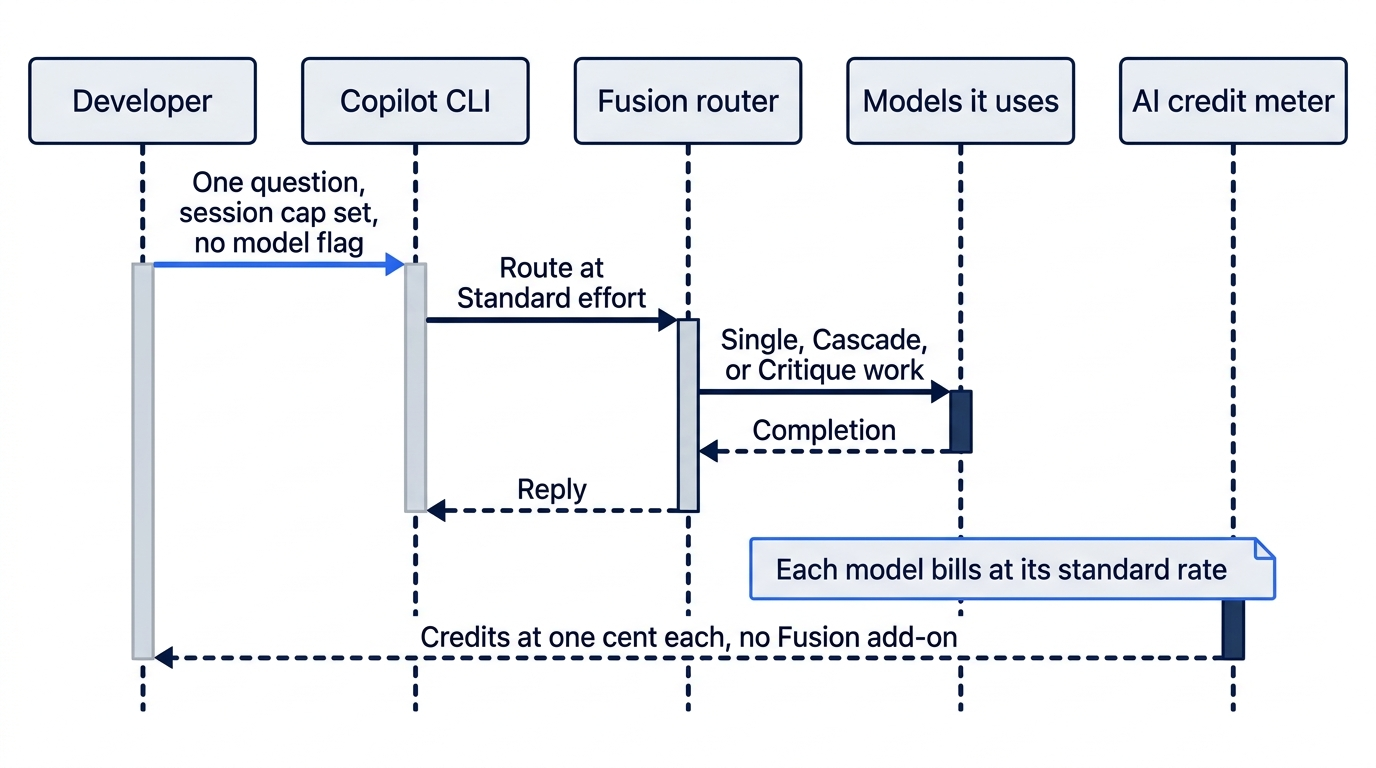
The CLI hands one capped question to Fusion at Standard, with no model flag and no Fusion flag. Single, Cascade, or Critique may run. Each model used is billed at that model's standard rate, at one cent per credit, with no separate Fusion charge, no monthly add-on, and no Fusion discount.
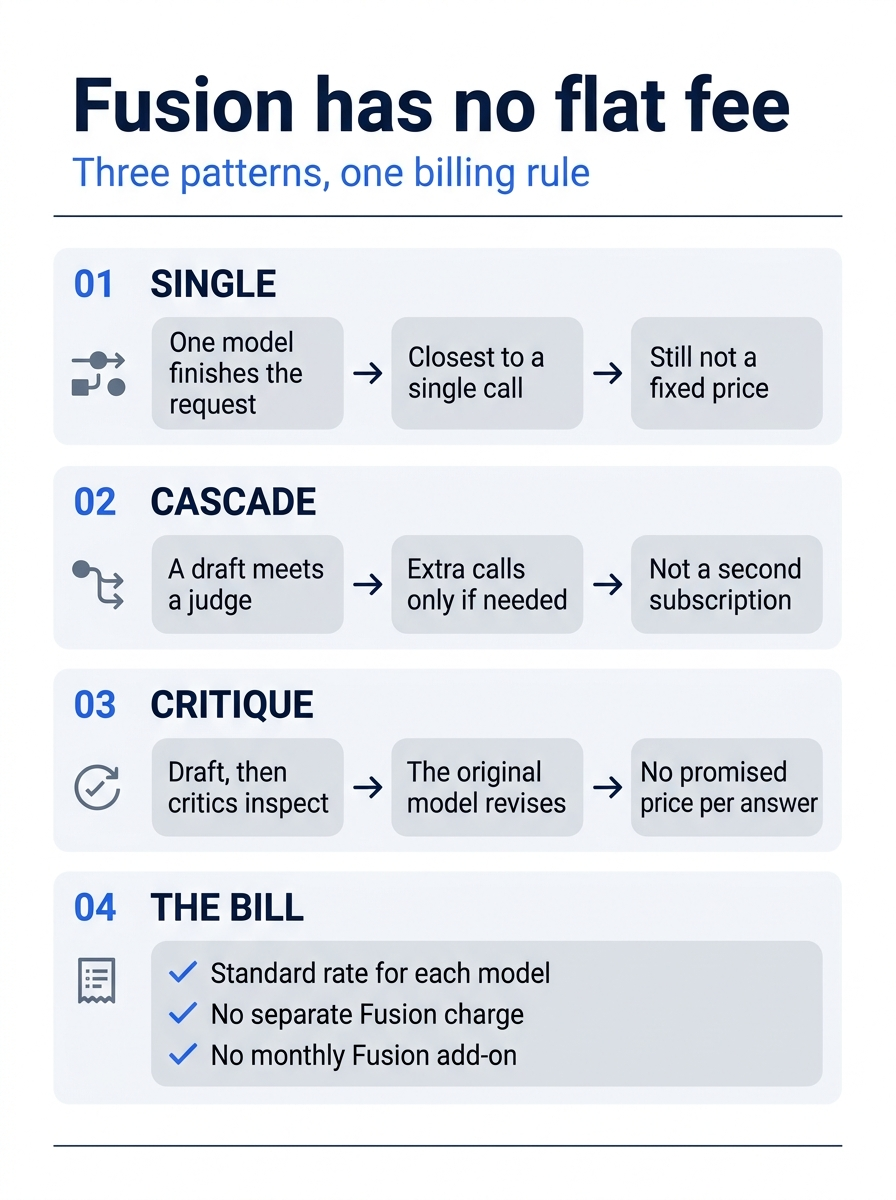
Single stays closest to one call and is still not a fixed price. Cascade adds calls only when a judge needs them, and it is not a second subscription. Critique drafts, inspects, and revises, with no promised price per answer. None of the three is a flat Fusion fee.
The models and pricing reference lists per-million-token input, cached-input, cache-write, and output rates. A long-context tier can change the rate. A task can include repeated text, cached reads, cache writes, more than one model, and compute. You do not copy a row from that page into your note. A row would be a model name plus a rate, and this article does not teach a model name.
Effort is not a plan price
Standard favors everyday efficiency. High and Max can spend more effort and can use orchestration. You already stayed on Standard. This article has no separate price for Standard, High, or Max. Do not invent one from the plan figures later. Those figures are included credits for a month. They are not a quote for an effort level.
Fast exists for VS Code inline chat and is not user-selectable. You do not hunt for a Fast control in the CLI picker. You do not treat a missing Fast entry as a broken session. You do not select Fast.
Local routing has two labels
The October 28, 2026 announcement calls local-model routing an experimental preview. The living Fusion page calls it a public preview. This article does not give a date when one label replaced the other. You record both. You do not invent the transition.
A local call can avoid a hosted charge. A mixed session can still call a hosted model and spend credits. Fusion Standard can use eligible local models. The notes describe local models that the CLI can recognize, including on Windows, macOS, and Linux. This article does not name those products. A product name here would read like a default model. You do not switch the Ticket Triage session onto a local model to redo the question.
What the plans included on November 16, 2026
Prices below are monthly US dollars before tax, as of November 16, 2026. Included credits are not a promise of unlimited agent tasks. One AI credit remains $0.01 on the individual billing page. Base is the subscription price converted into credits. On the Pro line, that is why $10 shows 1,000 base credits. Flex sits on top of base and can change. You use base first, then flex, at the same rates.
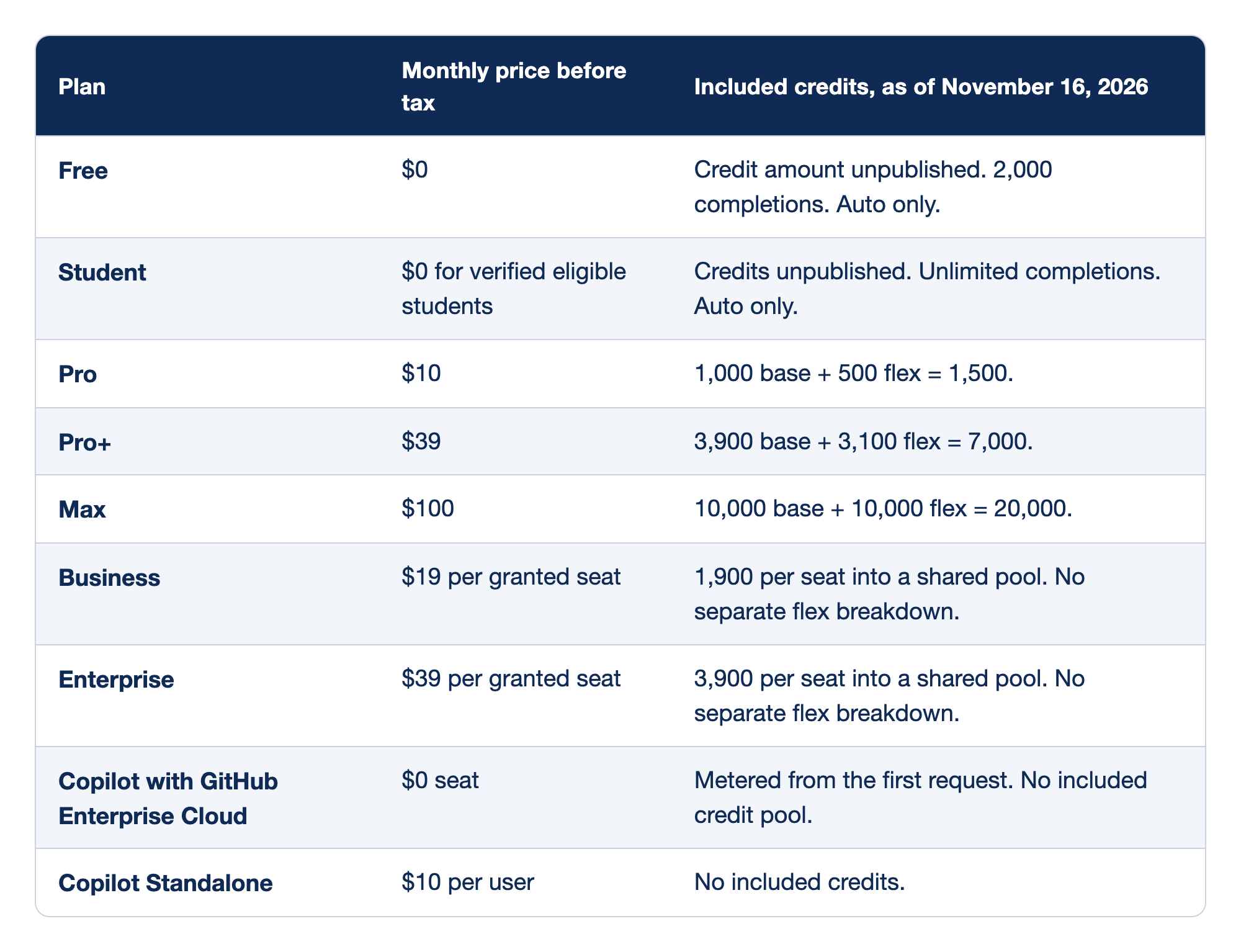
Nine Copilot plans show a monthly price and the included credits recorded on November 16, 2026. Plan is the product name. Monthly price before tax is the US dollar price for a month, before tax. Included credits, as of November 16, 2026, is the allowance listed for that day. It is not a promise of unlimited agent tasks, and it is not a quote for the CLI question you just asked. Totals that include flex are not a fixed permanent entitlement. The Max row is the Max plan. It is not Max effort from the picker.
- Free is $0 a month before tax. The credit allowance was not quantified on November 16, 2026, so you do not invent a credit total. The plan includes 2,000 completions a month and uses Auto only.
- Student is $0 for verified eligible students. Credits were unpublished on that date. Completions are unlimited. The plan uses Auto only. An account that is not verified does not get this row because you prefer the price.
- Pro is $10 a month before tax. The allowance is 1,000 base credits and 500 flex credits, which add to 1,500 on that date. Flex can change, so you do not treat 1,500 as a permanent entitlement. Pro is not the Standalone row, even though both show a $10 price.
- Pro+ is $39 a month before tax. The allowance is 3,900 base credits and 3,100 flex credits, which add to 7,000 on that date. The same flex warning applies. You do not add the Pro total on top of the Pro+ total.
- Max is $100 a month before tax. The allowance is 10,000 base credits and 10,000 flex credits, which add to 20,000 on that date. Max effort in the picker is a different word. You did not select Max effort, and this row does not require you to.
- Business is $19 per granted seat per month before tax. Each granted seat contributes 1,900 credits to a shared billing-entity pool. The notes do not split that 1,900 into base and flex. The pool is shared. It is not 1,900 private credits that only you can spend.
- Enterprise is $39 per granted seat per month before tax. Each granted seat contributes 3,900 credits to a shared billing-entity pool. The notes do not split that 3,900 into base and flex. Fusion on a work account still has to use models that enterprise, organization, or team policy enables. A shorter picker is policy. It is not a reason to pin whatever name remains.
- Copilot with GitHub Enterprise Cloud is a $0 seat charge for licensed enterprise users in the sales-led arrangement described here. There is no included monthly credit pool. Metered credits start at the first request. A Business seat at $19 is a different row. Do not describe this row as free usage.
- Copilot Standalone is $10 per user without a GitHub Enterprise Cloud license. The arrangement is enterprise-grade eligibility with no included monthly allowance, which means no included credits. The matching $10 on the Pro row includes credits. This row does not.
Copy your plan name from that list. If the billing page shows a name that is not there, write the name you saw and the words "not in the November 16, 2026 list." You do not invent a credit total for that name.
Base, flex, and a reset that does not roll
Base, in the billing page's description, does not change. Flex is additional included usage that can adapt as economics change. You draw base first, then flex, at the same rates. You do not describe the whole total as a fixed permanent entitlement. Unused included credits do not roll over.
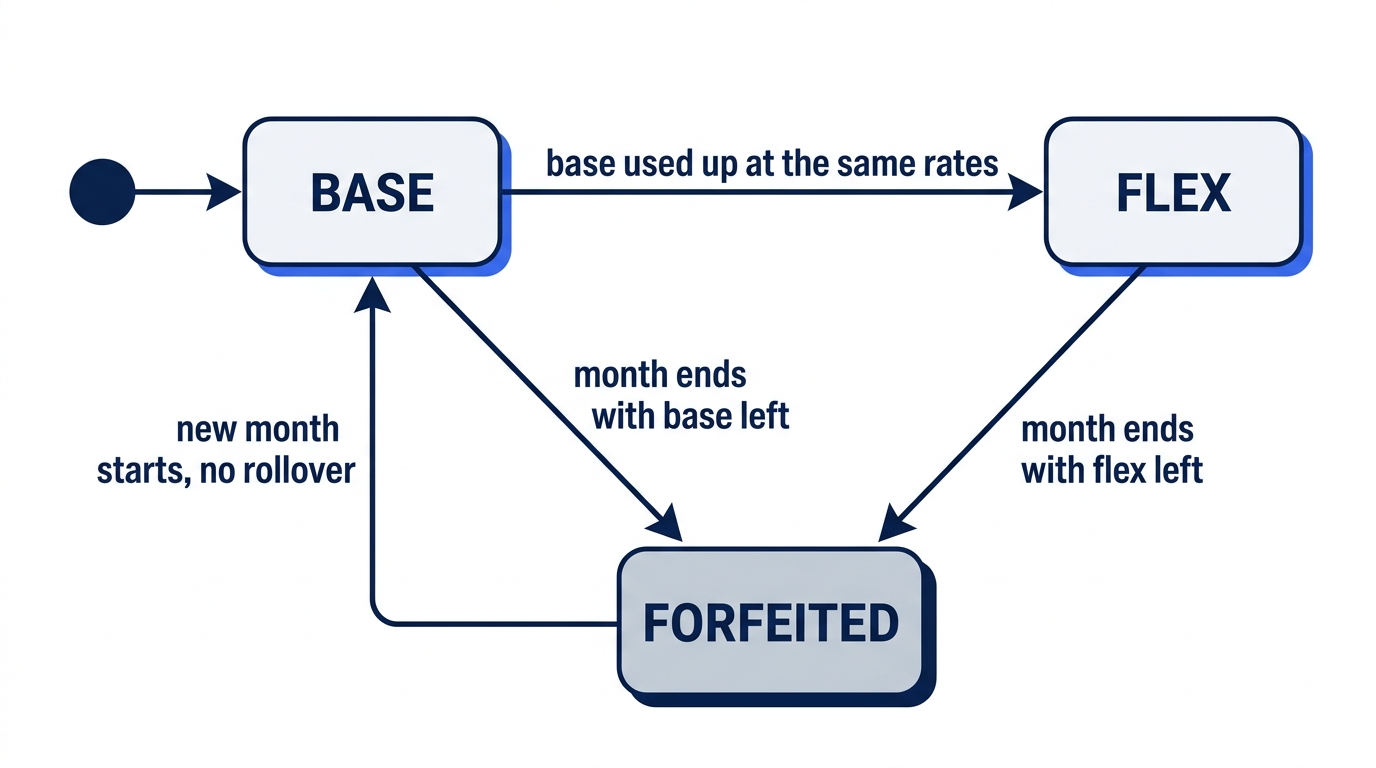
On plans that list both pools, you spend base first. When base is used up, flex continues at the same rates. At the month boundary, leftover base and leftover flex are forfeited, and the next month starts on base again. The boundary is 00:00 UTC at the start of each calendar month. Do not translate that instant into a US evening and then treat the evening as the rule. The subscription renewal date can differ from the credit reset. A renewal charge on some other day does not move unused credits into the next month. Business and Enterprise, in the November 16, 2026 figures, do not split their shared pools into base and flex. Free and Student credit amounts were unpublished. Copilot with GitHub Enterprise Cloud and Copilot Standalone have no included credit pool, so this draw order does not describe them.
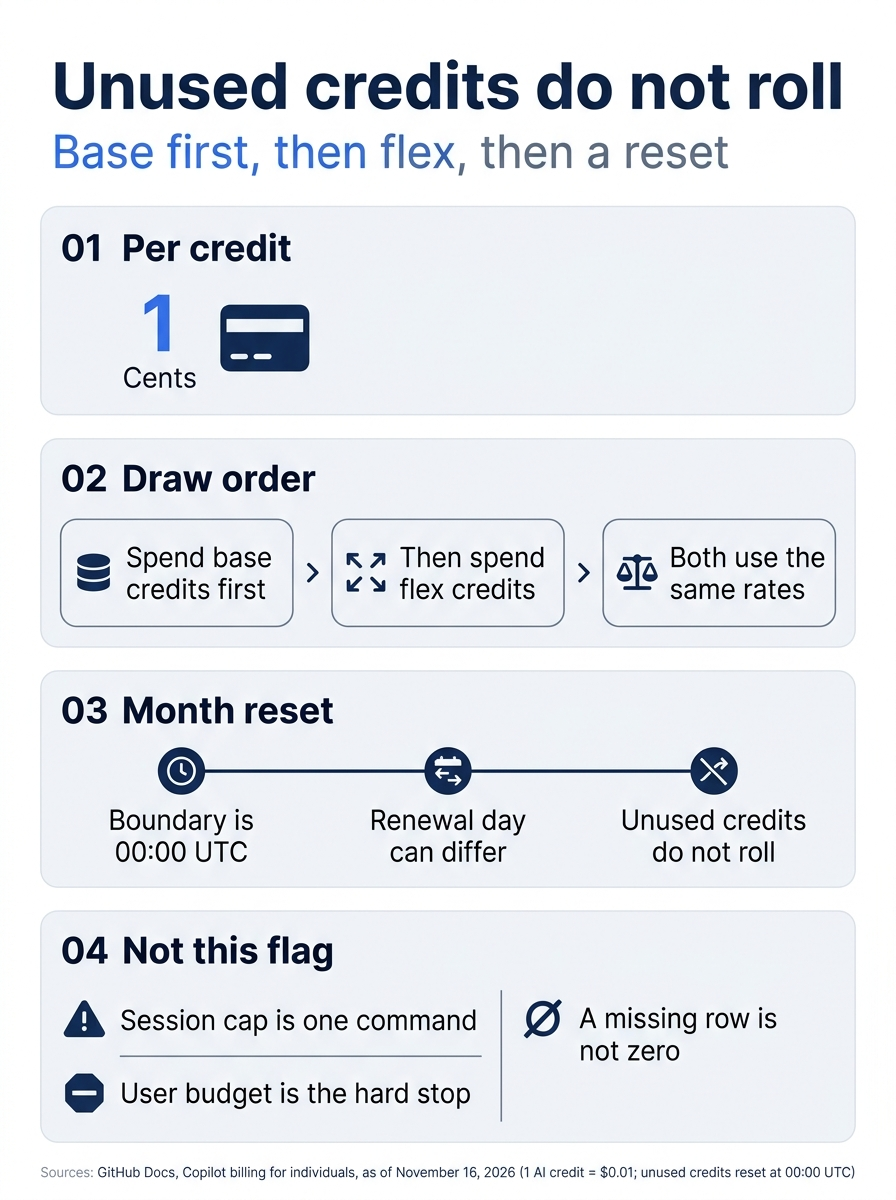
The unit is one cent per AI credit. Draw order is base, then flex, at the same rates. The reset boundary is 00:00 UTC, the renewal day can differ, and unused credits do not roll. A session cap is a different control from the user-level budget, and a usage row that has not appeared yet is not proof that the session spent nothing.
Some existing annual Pro and Pro+ customers can remain on legacy premium-request billing until that annual plan ends. Premium-request billing counted an interaction and applied a multiplier. Usage billing counts input, output, and cache tokens and converts that cost to credits. The June 1 launch post in these notes says "all users." The more specific legacy page supplies an exception. Do not tell every reader that every old annual subscription has already converted. The legacy page says those customers then move to Free unless they choose another path. The downgrade sentence is about the end of that legacy annual plan. It is not a step you take today, and it is not a reason to pick a model name before the plan ends.
Auto is a selector, not a model you pin
Auto is a selector, not a model you pin. Free and Student use Auto only. Paid Auto chooses among eligible models. The pool changes. As of November 16, 2026, paid Auto has a 10 percent model-cost discount in Chat and cloud-agent use. The notes do not state that same discount for the CLI session you just ran. The Auto selection page is the place to re-check the discount. You do not equate Auto with Fusion. Fusion is the router you selected for the CLI question. There is no Fusion discount.
Individual non-enterprise users can receive evaluation models through Auto. Those entries may use codenames, may change without notice, and may carry different limits. You can turn that off in Copilot settings. A codename is not a permanent production model. You do not record one as the model you use.
A retirement list is not a default
Six models retire on December 14, 2026. The changelog titles that date a deprecation: Upcoming deprecation of selected GitHub Copilot models in December. This article does not name the six. A written-down default goes stale when the list changes, which is why the walkthrough sent you to the picker and told you not to copy a name. On the day you read this, open the picker again. The list on that day is the list that counts. A name you saw in a note from November 2026 is not a default, even if the picker still shows it.
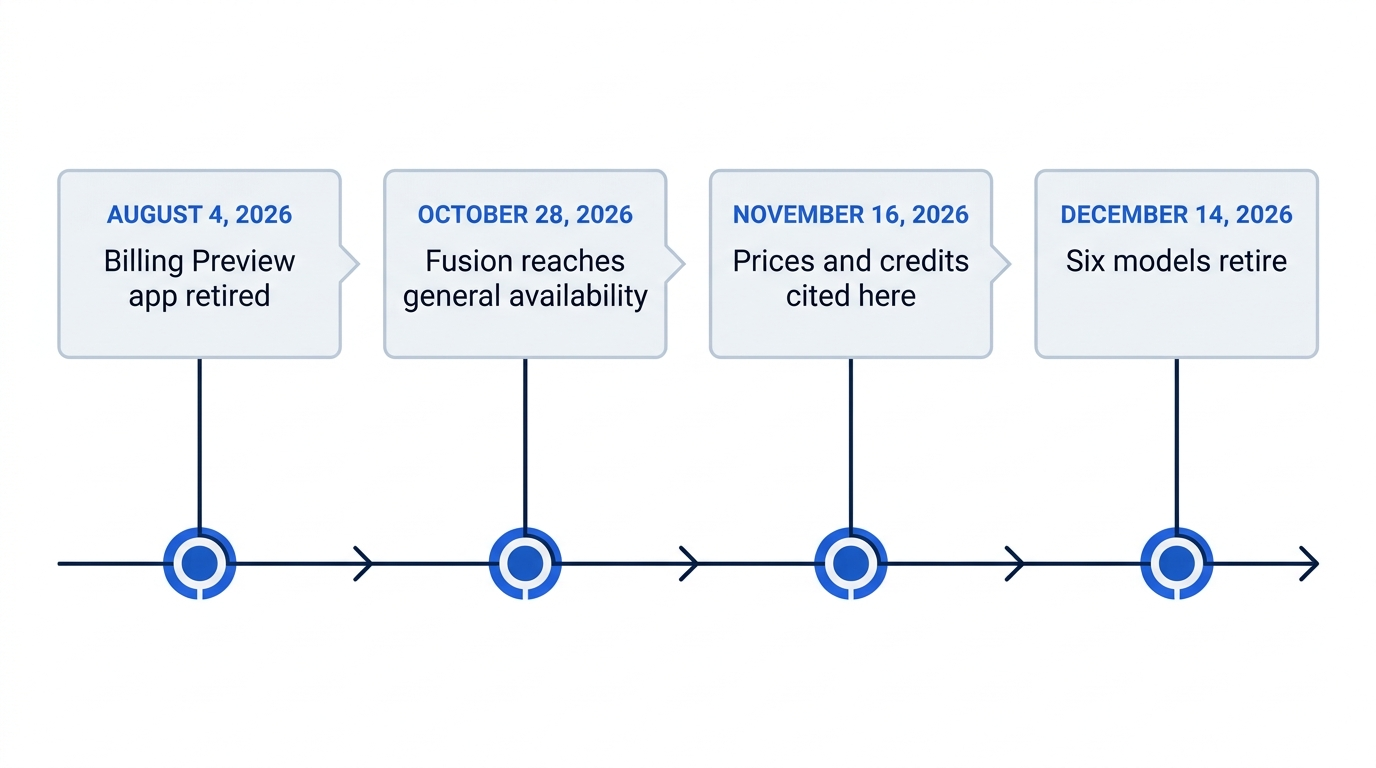
August 4, 2026 is when the Billing Preview app retired. October 28, 2026 is when Fusion reached general availability. November 16, 2026 is when these prices were recorded. December 14, 2026 is when six models retire. The last date is a reason to look at the picker again, not a shopping list, and this article still does not name the six.
Gotcha: naming "the" model from a picker, a price row, or a retirement list. The session you ran is Fusion at Standard, under --max-ai-credits. The retirement list is a reason to look again. It is not a shopping list.
The session cap is not the billing budget
--max-ai-credits bounds the session you started. It is not the user-level budget on the billing page. A user-level budget caps total use for the billing cycle, including the included pool, and it always hard-stops. A spending-limit budget is a different control, and it stops usage only when that option is on. Additional paid usage stays on by default for Business and Enterprise unless an admin disables the policy. Rate limits and the rules for additional use can still stop you while credits remain on the page.
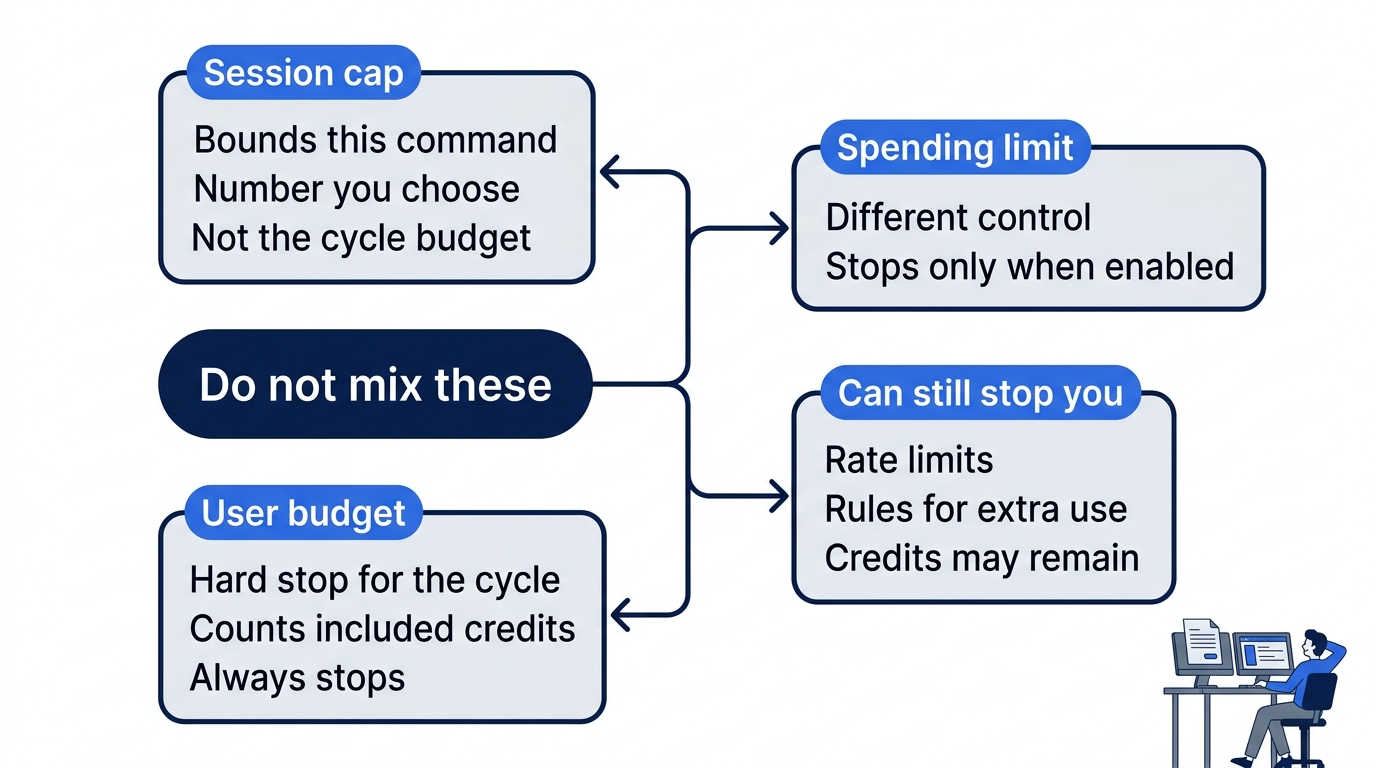
The session cap bounds one command. The number you choose is not the billing-cycle budget, not a day-1 budget, and not a price. The user-level budget hard-stops the whole cycle, including included credits. The spending limit stops usage only when that option is on. Rate limits can still stop you while credits remain. You do not raise today's number because a rate limit fired, and you do not treat a missing usage row as proof that the session spent nothing. The command line is the proof of the cap. The page is the proof that you looked.
If you have used Claude Code: a Claude plan's monthly price is not an AI credit. As of November 16, 2026, Claude Pro is $20 monthly or a $17 annual-equivalent, Claude Max is $100 monthly, and Claude Ultra is $200 monthly, with limits still applying (Claude pricing).
Do this today
- From
~/code/ticket-triage, the command you ran contained--max-ai-creditsand the small number you chose, and it did not contain a model name, a Fusion flag,--yolo,--allow-all, or--allow-all-tools. The check is that line in your shell history. The number you picked is not the user-level billing budget, not a day-1 budget, and not a price. On Windows, use the same command from the Ticket Triage folder. - The picker selection was Copilot Fusion at Standard effort. The check is one note that says those two things and names no model. If Fusion was missing, the note says you stopped, did not substitute a name, and did not ask the question.
- You wrote the human answer only after reading
test/classify.test.js:crushed mug in pieces is otherkeeps the crushed-mug sentence returningother, andsrc/classify.jsis unchanged. The check is that sentence in your note, matched to the file, not a paste of the reply. Re-run this on your account before you trust the wording of any reply you saw. There is no transcript from November 16, 2026. - The AI usage page in GitHub billing settings was open, and you were not in the Billing Preview app that retired on August 4, 2026. If this session was not listed yet, the note says "usage page open, session not listed yet." You did not change the user-level budget.
git status --shortprints nothing.git log -1 --onelinematches the line you copied before the session. Both diffs print nothing.npm teststill shows the four names,# tests 4,# pass 4, and# fail 0. You did not commit.- Write your plan name, the monthly price before tax, and this sentence: unused included credits do not roll over. If the plan is Free or Student, also write that the credit amount was unpublished as of November 16, 2026, and that the plan uses Auto only. If the billing page shows a plan name that is not in the list, write the name you saw and the words "not in the November 16, 2026 list." You do not invent a credit total for that name.
A name was never the price
You opened the picker looking for a safe default and a knowable price. Fusion at Standard is a route and an effort, not a model you can paste into next month's notes. The GitHub Copilot Fusion cost of the turn is whatever models and tokens that route actually used, each at that model's standard rate. There is no separate Fusion charge, no monthly add-on, no Fusion CLI flag, and no Fusion discount. The placeholder 20 on --max-ai-credits only shows where your own number goes. It is not a day-1 budget, and it is not a price.
The picker will still show names after December 14, 2026, and six of today's names will not. The session you can defend does not depend on which name was highlighted. It depends on a cap you typed, Fusion at Standard, and a test file you read yourself.
This is Part 6 of "GitHub Copilot, Day-to-Day," a 16-part guide to using GitHub Copilot as a daily coding agent.