
Crew or Flow? The Two Questions That Actually Decide It
The real answer to 'Crew or Flow?' is not a slogan. It is reading your problem on two axes and letting the architecture follow from where it lands.
Most advice on CrewAI Crews vs Flows collapses to a slogan. The real answer is reading your problem on two axes, then letting the architecture fall out of where it lands.
Stop cargo-culting 'start with a Flow.' Learn the two questions that actually decide it, so you stop wrapping ceremony around problems that did not ask for it. Most advice on CrewAI Crews vs Flows collapses to a slogan. The real answer is reading your problem on two axes, then letting the architecture fall out of where it lands.
In this article: A pragmatic decision guide for the CrewAI Crews vs Flows question. You will learn the two axes that actually matter, the four quadrants and what each one points to, a quick scoring method for when intuition stalls, a translation table from "I want to do X" to the right primitive, and why "start with a Flow" is still the default even after all that nuance.
You have probably seen the advice in three different blog posts: start with a Flow, and put Crews inside it for the parts that need autonomy. It is correct often enough to be a sensible default, and a default is exactly what you want when you are learning. But "always start with a Flow" is a heuristic, not a law. There are real cases where a bare Crew is the right call and wrapping it in a Flow is just ceremony you will end up deleting.
The honest answer to CrewAI Crews vs Flows is not a slogan. It is two questions about your problem. Once you can answer them, the architecture stops feeling like a coin flip and starts feeling obvious.
This appendix is the reasoning underneath the heuristic, so you can tell the difference.
The two axes
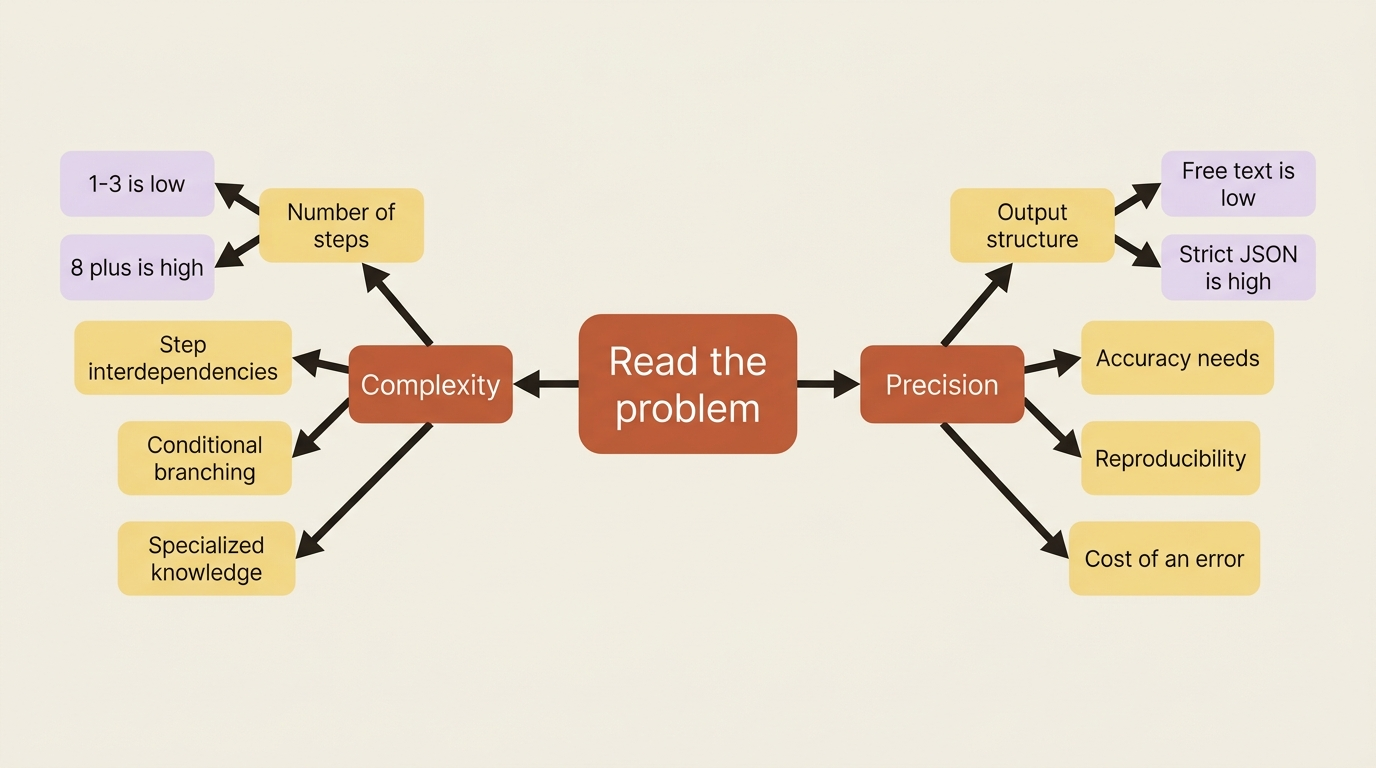
CrewAI's own framework measures a use case along complexity and precision, and the two are genuinely different things. People conflate them, then pick the wrong primitive because they collapsed a 2x2 into a coin toss.
Complexity is about how much workflow there is. How many distinct steps the job takes, how much the steps depend on each other, how much branching and conditional logic is involved, and how specialized the knowledge has to be. A one-shot summary is low complexity. A multi-stage pipeline with decisions at each gate is high complexity.
Precision is about how exact the output must be. How structured it has to be, how reproducible across runs, how costly an error is, and how much variation you can tolerate. A brainstorm is low precision, because variation is fine and even welcome. A JSON payload another system will parse, or a number a regulator will audit, is high precision, because one wrong field is a failure.
These two dimensions do not move together. You can have a simple job that demands an exact answer, or a sprawling job where some looseness in the final output is fine. That is why one axis cannot decide for you, and why the four combinations point to four different answers.
The four quadrants
Read where your problem sits, and the architecture follows.
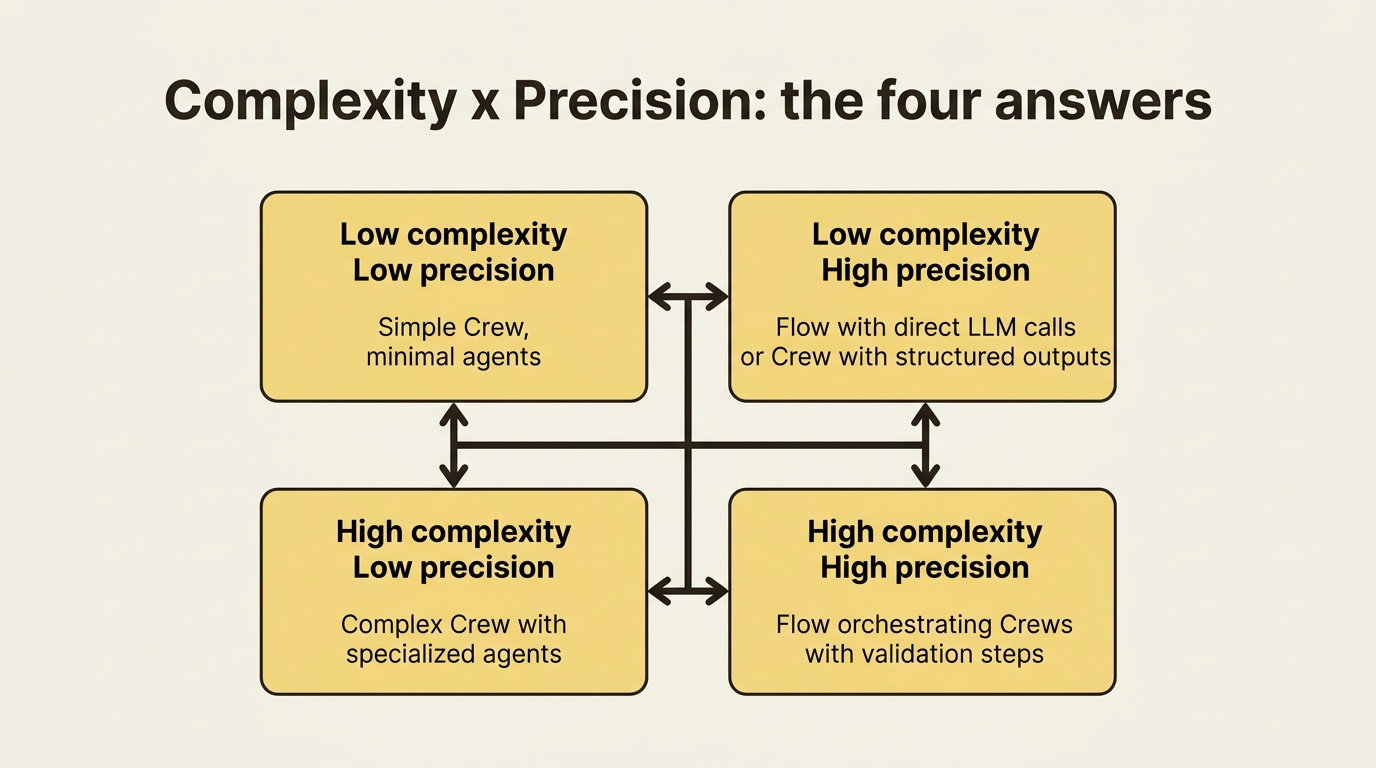
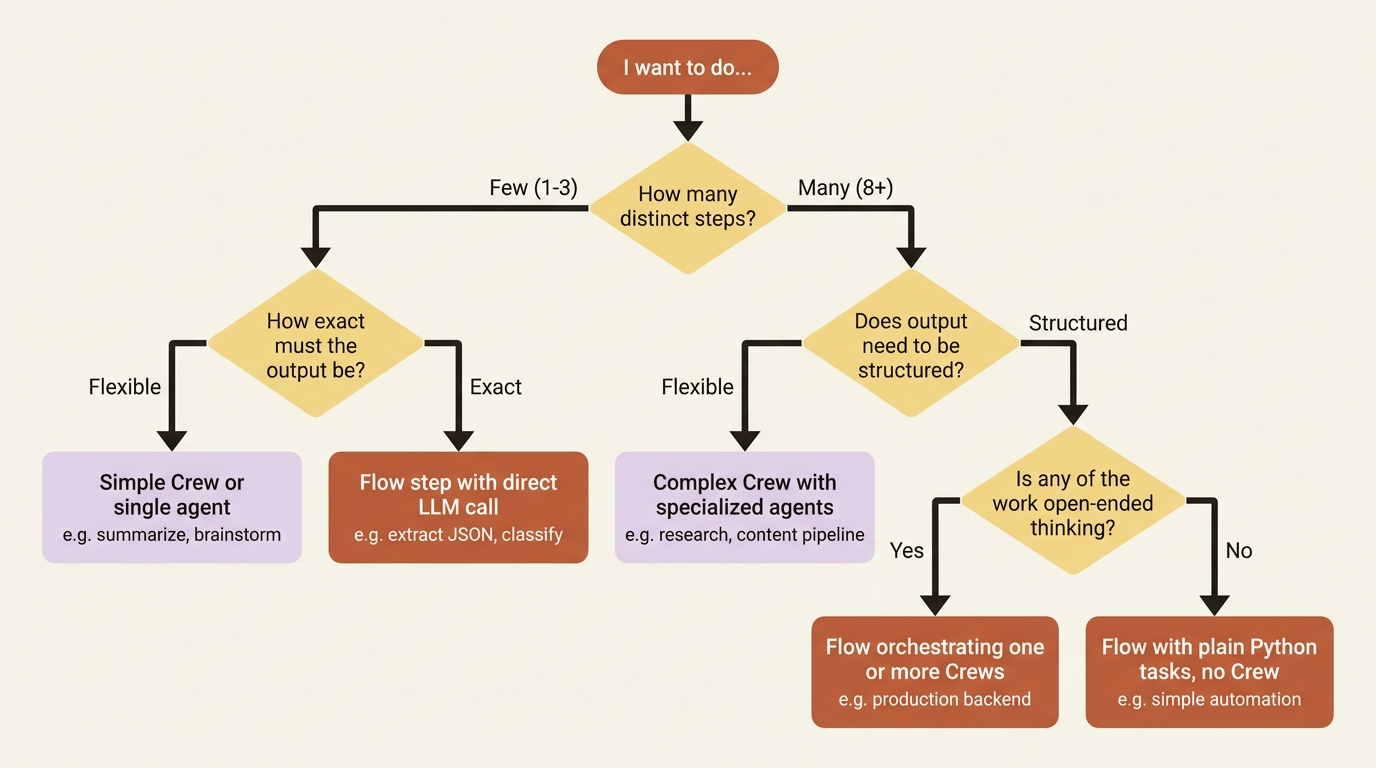
Low complexity, low precision points to a simple Crew with a couple of agents. Few steps, variation is acceptable, so the lightest thing works. Think basic content generation, brainstorming, or a quick summary. A Flow here is overhead with nothing to manage.
Low complexity, high precision points to a Flow with direct LLM calls, or a simple Crew with structured outputs. The job is short, but the answer must be exact and reproducible, so you want the control and the typed output more than you want agent autonomy. Think data extraction, form validation, or classification.
High complexity, low precision points to a complex Crew with several specialized agents. There is a lot of work and it benefits from different perspectives, but the final form can flex. This is the sweet spot for agent collaboration: research, content pipelines, exploratory analysis, and creative problem-solving. Let the agents be autonomous; you are not policing the exact shape of the result.
High complexity, high precision points to a Flow orchestrating one or more Crews, with validation steps. Many interdependent steps and strict accuracy, which describes most real production systems. The Flow owns the structure, state, and the gates; the Crews do the open-ended thinking inside that structure. This is the quadrant most serious applications live in, and it is why "start with a Flow" is such a reliable default.
For a quick reference:
- Low complexity, low precision: a simple Crew with minimal agents.
- Low complexity, high precision: a Flow with direct LLM calls, or a simple Crew with structured outputs.
- High complexity, low precision: a complex Crew with multiple specialized agents.
- High complexity, high precision: a Flow orchestrating multiple Crews with validation steps.
Scoring it, roughly
You do not need a spreadsheet, but a rough number helps when intuition stalls.
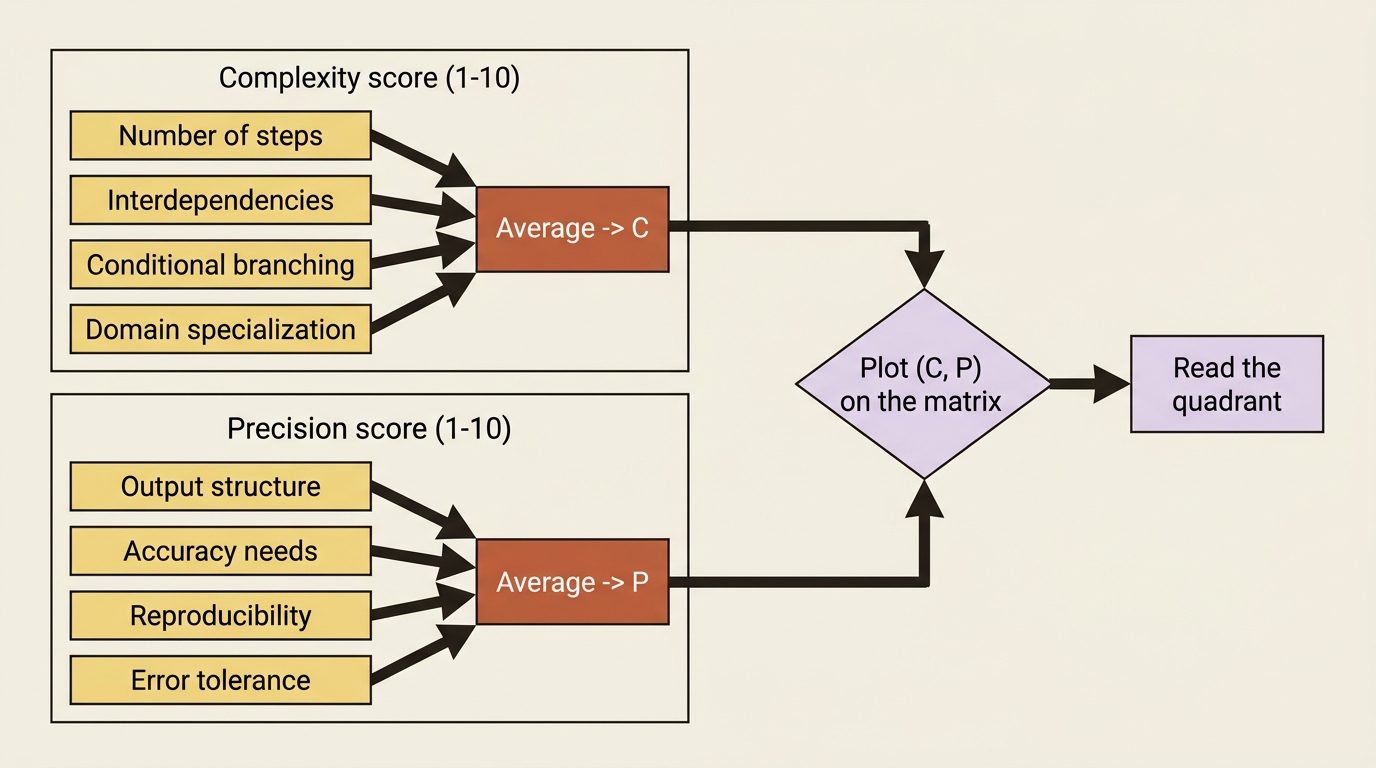
Rate complexity 1 to 10 by averaging four things: number of steps (1 to 3 steps is low, 8-plus is high), interdependencies between steps, how much conditional branching there is, and how specialized the domain knowledge must be. Rate precision 1 to 10 the same way: output structure (free text is low, strict JSON is high), accuracy needs, reproducibility, and error tolerance.
Then map the two averages onto the quadrant grid. Complexity 1 to 4 with precision 1 to 4 is a simple Crew. Low complexity with high precision is a Flow with direct LLM calls. High complexity with low precision is a complex Crew. High complexity with high precision is a Flow orchestrating Crews.
The numbers are not magic. They just force you to look at all four sub-factors instead of reacting to whichever one is shouting loudest in the room.
"I want to do X" → reach for this
Concrete beats abstract, so here is the translation from a thing you might actually be trying to build to the primitive that fits.
- "Summarize this document." A single Crew, or honestly a single agent.
- "Extract these fields into JSON, reliably." A Flow step with a direct LLM call and structured output, where precision is the whole point.
- "Research a topic from several angles and write it up." A Crew of specialists, where collaboration and emergent thinking are the value.
- "Handle an API request, generate content, save to a database." A Flow managing the request and persistence, with a Crew for the generation step in the middle.
- "Run a simple automation with a few deterministic steps." A single Flow with plain Python tasks, no Crew needed at all.
- "Build a production application backend." A Flow for structure, state, and control, calling Crews where the work genuinely needs autonomy.
Notice the bottom two. A Flow does not require a Crew, and a job can be all workflow with no autonomous thinking in it. That is the case the "start with a Flow" advice quietly covers and the "always use a Crew" instinct misses entirely.
Why "start with a Flow" is still the default
Given all that nuance, why does the official guidance still collapse to "use both, start with a Flow"?
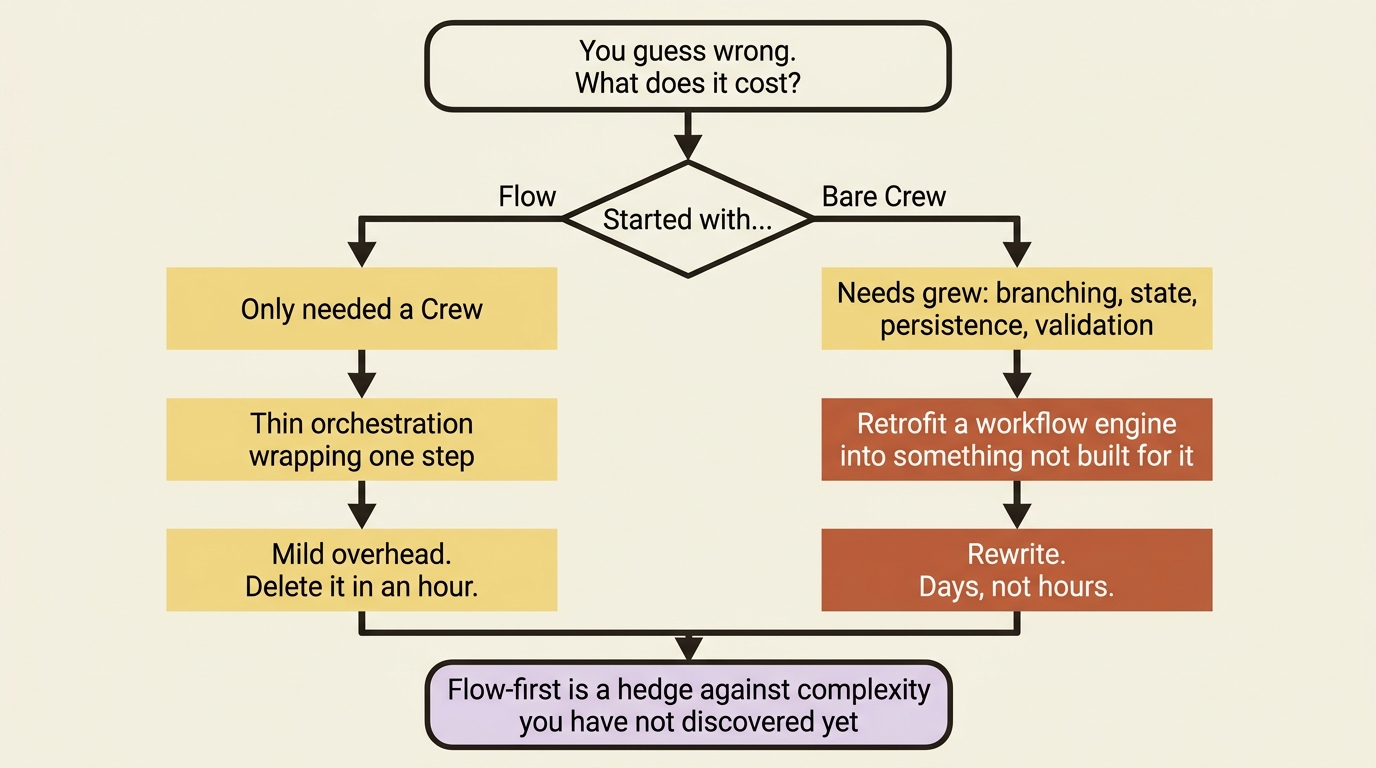
Because the cost of guessing wrong is asymmetric.
If you start with a Flow and it turns out you only needed a Crew, you have a thin orchestration layer wrapping one step. That is mild overhead and easy to delete in an hour. If you start with a bare Crew and your needs grow into branching, state, persistence, and validation, you are retrofitting all of that into something that was not built to hold it. That is a rewrite.
The Flow-first default is a hedge against complexity you have not discovered yet, and most production systems eventually discover it.
There are practical tiebreakers when the quadrant is genuinely ambiguous. Crews are faster to prototype, so for a throwaway or an experiment, reach for the Crew and skip the ceremony. Flows are more maintainable long-term and scale better as the workflow grows, so for anything you will still be running in six months, the Flow earns its keep. And match the choice to your team: the simplest thing that meets the need today, with room to grow, beats the most sophisticated thing you can justify.
Do this today
Before you start your next CrewAI project, run the framework on it:
- Score your problem on both axes. Rate complexity 1 to 10 by averaging steps, interdependencies, branching, and specialization. Rate precision 1 to 10 by averaging structure, accuracy, reproducibility, and error tolerance. Write the two numbers down.
- Plot the pair on the quadrant grid. Read off the recommended architecture. If the recommendation surprises you, that is the point. The framework exists for the moments your gut is wrong.
- Sanity-check it against "I want to do X." If your problem matches one of the six examples, use that primitive. If it does not match cleanly, you are probably in the High/High quadrant by default.
- When in doubt, start with a Flow. Then put a Crew inside it only where the work needs autonomy. The asymmetric cost of guessing wrong favors this every time.
- Bookmark the CrewAI evaluating-use-cases guide. It is the canonical version of this framework, kept current with the framework itself.
The honest closing note
The right architecture often changes as the application matures. Start with the simplest thing that solves the problem in front of you, and let the structure grow as the requirements clarify. You do not have to pick the final architecture on day one. You have to pick the one that fits what you know now and does not box you in later.
That is what the CrewAI Crews vs Flows decision is actually about. Not picking the cool primitive. Not following the slogan. Reading your own problem accurately enough that the answer becomes obvious, and being honest about the cost of being wrong in either direction.
Flow-first is mostly a bet on "later" arriving. In production, "later" almost always arrives.