
The GitHub Copilot Cloud Agent Opened a Pull Request. Leave It as a Draft.
Hand one Ticket Triage issue to the GitHub Copilot cloud agent with a single CLI prompt, leave the pull request as a draft, and prove the laptop checkout never changed.
Hand the crushed-mug issue to the cloud with one prompt, read the diff, and prove src/classify.js on your laptop did not change.
The cloud agent opened a pull request for the crushed-mug bug, and the merge button is the obvious next click. The win is a draft you read and leave alone, while the files on your laptop stay exactly as they were.
In this article: You will hand one open Ticket Triage issue to the GitHub Copilot cloud agent with
&or/delegate, then stop at the draft. You will see why a checkpoint is a local branch you decline when git status is empty, why auto-merge stays off, and what the cloud firewall does and does not cover. By the end you have a draft URL or a written refusal, andsrc/classify.json your laptop is unchanged.
Preview: written November 16, 2026, before Microsoft Ignite. Some paid steps are not yet tested live; this guide will be updated November 21, 2026.
The crushed-mug ticket is still open. Damaged parcels should return shipping, and refund when the customer also wants money back. The sentence is "The box showed up crushed and the mug inside is in pieces." On your laptop, src/classify.js still returns other, the matching test still expects other, and four tests pass.
The tempting move is to let an agent edit the file in the folder you have open. You do the opposite. You hand that one issue to a GitHub Copilot cloud agent, read the draft pull request it opens, and stop. You do not merge. The classifier on your machine stays as it was.
GitHub's coding agent became generally available for paid plans on September 25, 2025 (Copilot coding agent is now generally available). Auto-merge, the switch that merges a pull request without you merging it by hand, stays off. The CLI for this work is Copilot CLI 1.0.112 as of November 16, 2026. This cloud turn was not run that day, and this article has no successful pull-request transcript. Re-run the handoff on your account before you trust the wording.
Starting fresh or fell behind? Run git switch -C main copilot/day-10. This replaces your main with the end of Day 10; to keep your own work, run git branch my-backup first.
A cloud agent opens a draft, and you do not merge it
A cloud agent works in a remote environment and opens a draft pull request. A draft pull request is not ready to merge. You do not merge it today. By the end you have either a draft URL written down or a written refusal, and you have not merged anything.
You need an eligible paid plan, and your organization's cloud-agent policy has to be enabled. There is no settings tour and no second route. The handoff command is the check.
If the product refuses, write the refusal in your own words and stop. The check is this sentence: the product refused, and you did not work around it with --yolo. Do not add a remote workaround, a personal access token, --allow-all, or --allow-all-tools. A missing URL is a stop. You do not keep rephrasing until a pull request appears. --yolo after a refusal allows tools, paths, and URLs. Auto-merge would land code you have not merged by hand.
Check the version, and do not reinstall. If the printed line is not 1.0.112, write the real line down.
copilot --version
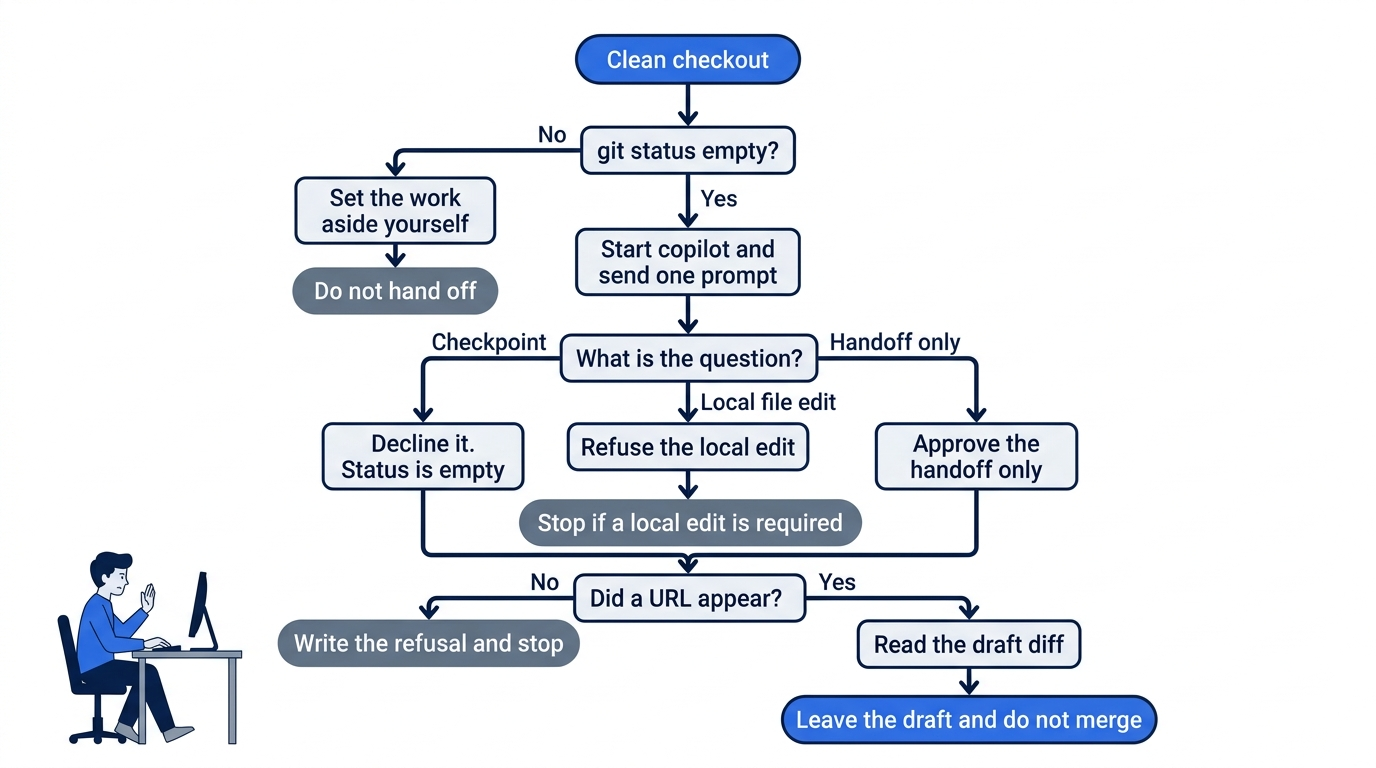
An empty status is the only start. Decline a checkpoint or a local edit. A missing URL is a written refusal. A URL is a draft you read and leave open.
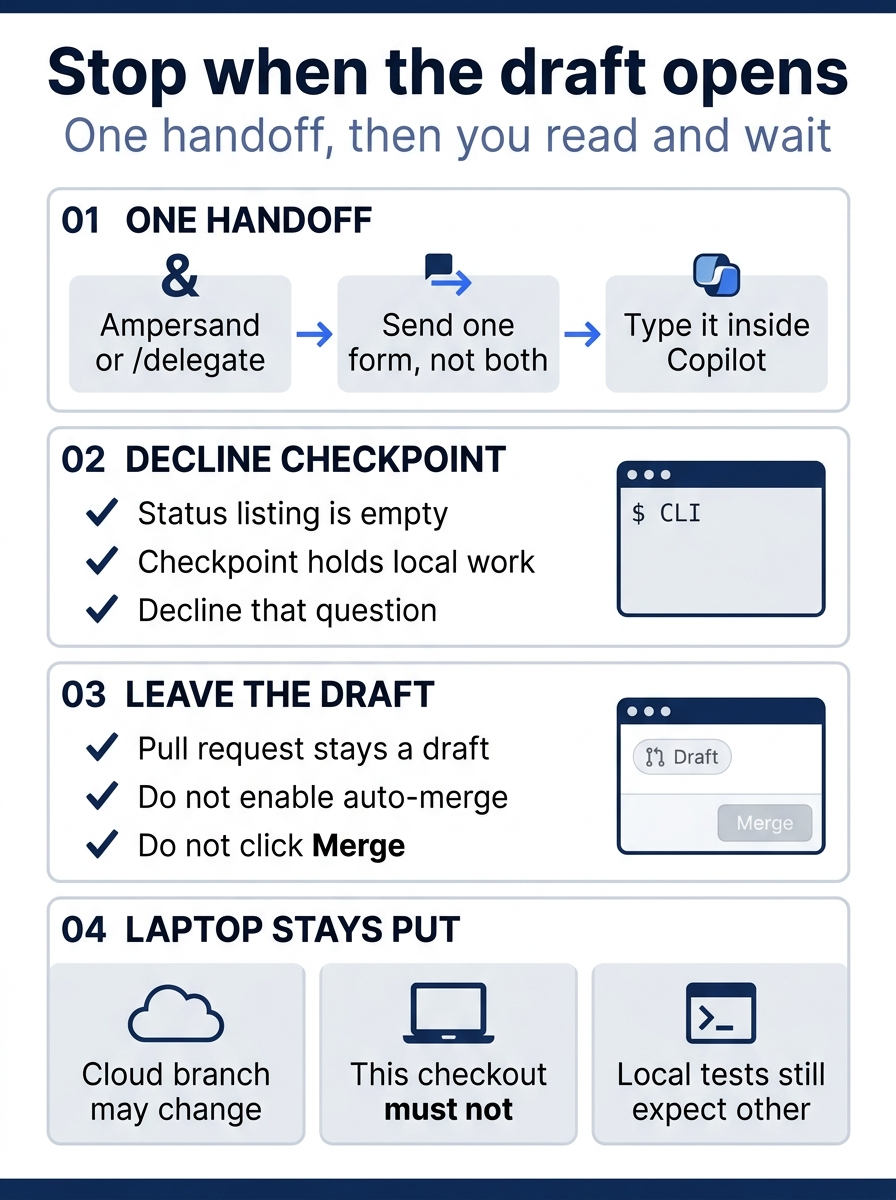
You send one handoff, decline a checkpoint when status is empty, leave the pull request as a draft with auto-merge off, and keep the laptop on the old other expectation.
Confirm the tree before you hand anything off
Work in ~/code/ticket-triage. On Windows, use C:\code\ticket-triage if that is where you created the project, and run the blocks in Git Bash.
The issue is already open. Its title is Crushed parcels should not stay other. Replace the characters ISSUE_NUMBER in the prompt with the digits from that issue. Do not open a second issue. If you did not keep the number, open the existing issue with that title and copy the digits.
cd ~/code/ticket-triage
git diff -- src/classify.js
git status --short
npm test
On the clean checkout this day starts from, git diff -- src/classify.js prints nothing. git status --short prints nothing. npm test reports four names: refund, shipping, other, and crushed mug in pieces is other, plus # tests 4, # pass 4, and # fail 0.
If a check fails, stop. Do not start the handoff. If status prints any path, the tree is not that clean checkout. Commit or set aside that work yourself, outside this session, until status is empty. Do not use the cloud prompt as a way to tidy the folder.
Send one prompt inside Copilot
Start a new session in the clean tree. Pass no model name. Do not pass --continue, --yolo, --allow-all, or --allow-all-tools. If the only way forward is a model name, stop.
cd ~/code/ticket-triage
copilot
You send one prompt, not two. The short form is the & line. The & prefix hands the rest of the line to the cloud agent. The long form is /delegate with the same words. The documented forms are on the delegation how-to.
Type the line in the Copilot session, after copilot is running. Do not paste it into zsh or bash. In those shells, a leading & backgrounds a command. It is not the Copilot prefix.
Type the & line. The /delegate line is the same handoff if you want the long form instead. After you send one of them, do not send the other.
& Implement issue ISSUE_NUMBER. Damaged parcels return shipping. If the customer also wants money back, return refund. Update the test that currently expects the crushed-mug sentence to return other. Leave the pull request as a draft. Do not enable auto-merge.
The long form, if you need it, is the same sentence after /delegate.
/delegate Implement issue ISSUE_NUMBER. Damaged parcels return shipping. If the customer also wants money back, return refund. Update the test that currently expects the crushed-mug sentence to return other. Leave the pull request as a draft. Do not enable auto-merge.
The CLI may ask you to checkpoint unstaged changes. A checkpoint is a local branch for uncommitted work. Your status is already empty, so you decline that question. If the question appears, look again in another terminal.
git status --short
An empty listing still means that you do not approve a local edit. If a question is about changing src/classify.js or test/classify.test.js on this machine, refuse it. If a question is only whether to hand the task to the cloud agent, that question is the handoff. Approve the handoff only. There is no sample wording for either question. Re-run this on your account before you trust the wording. This cloud turn was not run on November 16, 2026.
If you cannot continue without approving a local edit, stop. Write "local edit requested" and treat it as a refusal. Do not pass --yolo to skip the question.
/delegate --base BRANCH would change the target branch. BRANCH is a name you would substitute. You do not pass --base today. The handoff you already sent, if you sent one, is the one that counts.
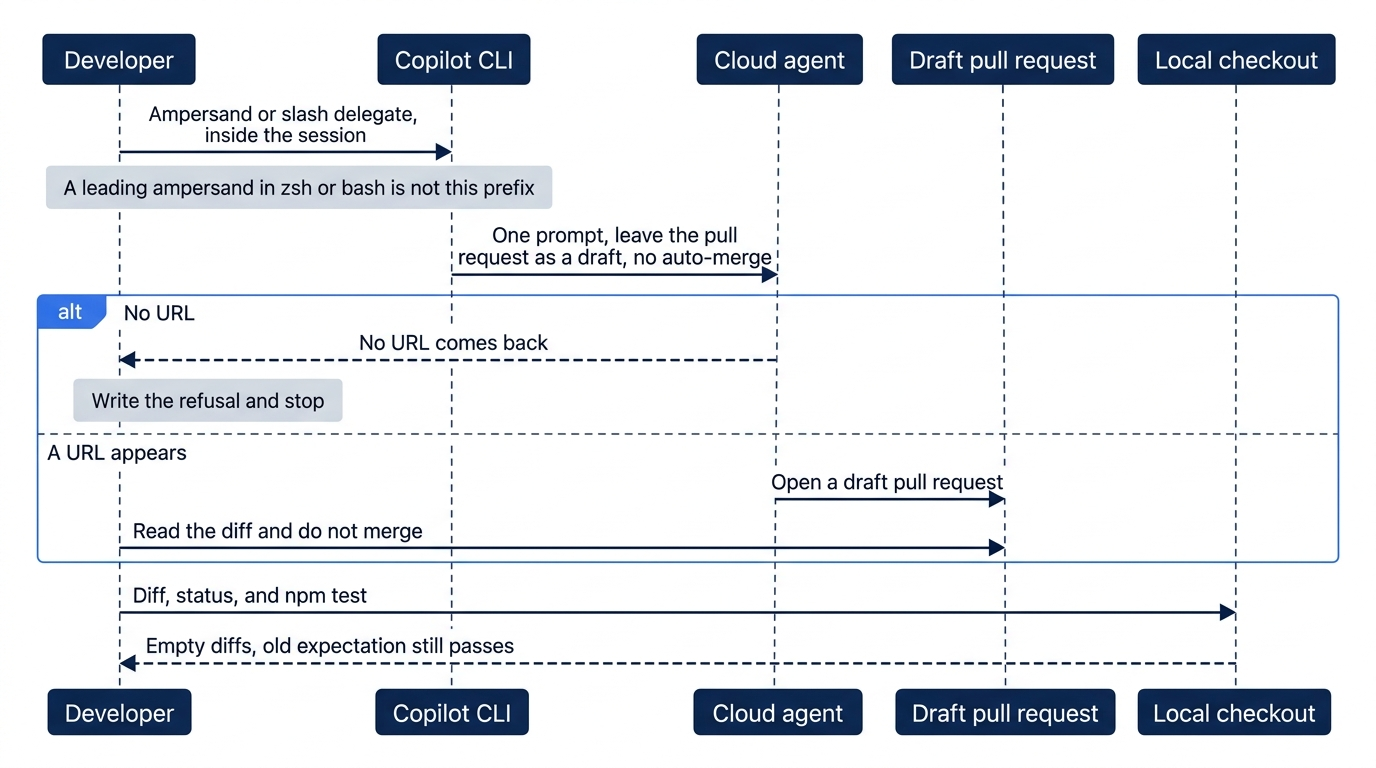
The CLI hands one prompt to the cloud agent. You read a draft if a URL appears, and you do not merge it. The laptop checkout only answers a diff, a status, and npm test.
Read the draft, then leave it a draft
When a URL appears, write the whole URL in your notes and open it. Read the diff. You are not finishing the pull request. Search for the crushed-mug sentence, The box showed up crushed and the mug inside is in pieces, and for a change to the test that currently expects other. The prompt also asked for shipping on a damaged parcel, and refund when the customer also wants money back. Seeing that expectation move is the read. Judging the keywords as final is not today's job.
Confirm the pull request is still a draft and that auto-merge is not enabled. If you cannot find an auto-merge control, write "no auto-merge control seen" and still do not merge. Do not click Ready for review. Do not click Merge. Do not check out the pull request branch, and do not pull it into ~/code/ticket-triage. A checkout would make this folder match the cloud branch, and the local proof would stop meaning what it says.
If the diff does something else, or the URL never shows a diff, leave any pull request as a draft, write what you saw, and stop. Do not repair it with a local edit. If no URL appears, write the refusal in your own words and stop. /exit closes the session when it is still open.
/exit
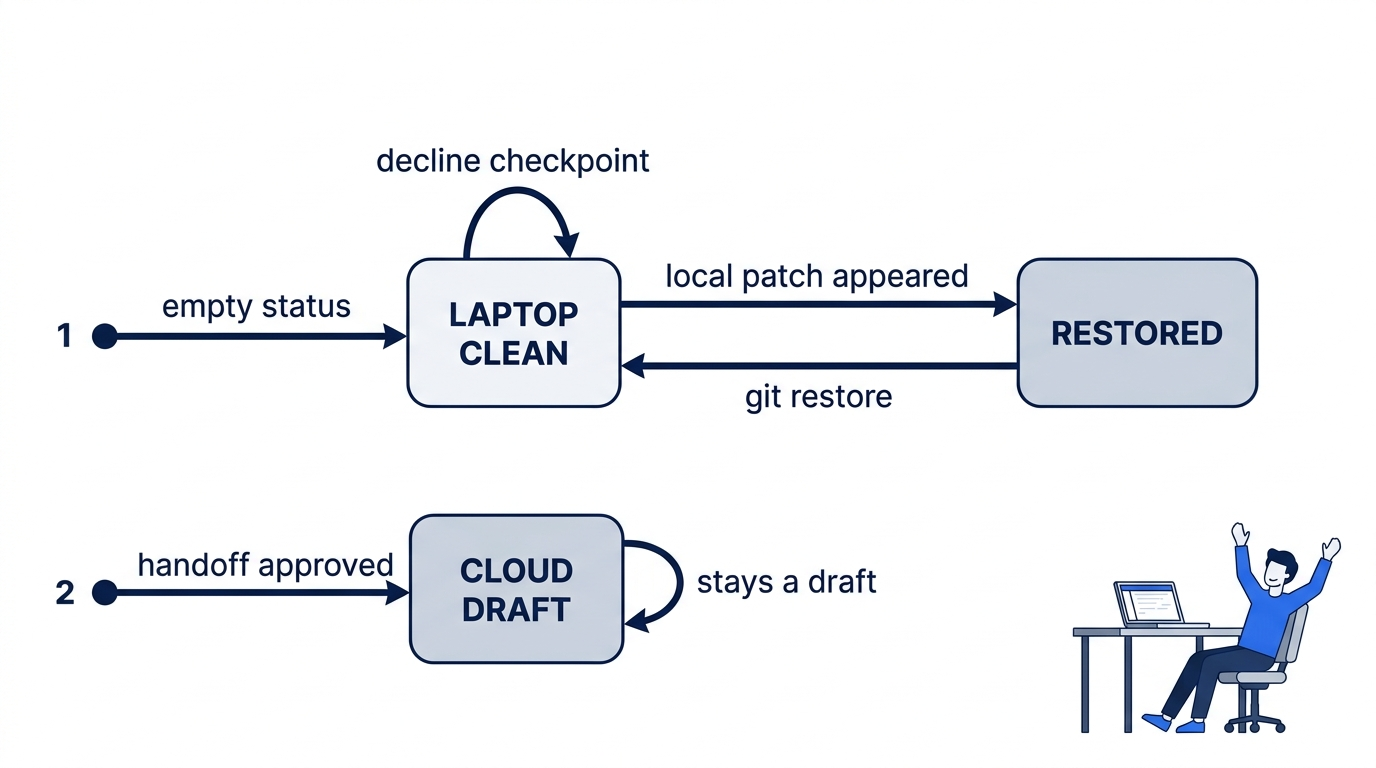
The cloud branch may hold the agent's edit. This checkout must not. If a local patch appears, git restore puts the files back, and you still do not commit that patch. The scene is the moment after a clean read: the draft is on the screen, and your hands stay off Merge.
Prove the laptop copy never moved
The draft is the work. npm test in this folder does not run the cloud branch. It runs the files on this machine. Those files still have the old expectation. An old other result from the local crushed-mug test is not a failure.
cd ~/code/ticket-triage
git diff -- src/classify.js
git diff -- test/classify.test.js
git status --short
npm test
git diff -- src/classify.js prints nothing. The test-file diff prints nothing. git status --short prints nothing. npm test still shows the four names, # tests 4, # pass 4, and # fail 0. The line for crushed mug in pieces is other can still be a pass under the old expectation.
If the classifier diff prints a patch, you approved a local edit. Restore the file and do not commit it.
git restore -- src/classify.js test/classify.test.js
git diff -- src/classify.js
npm test
After the restore, the classifier diff prints nothing, and npm test still shows # pass 4 and # fail 0. The cloud branch may still contain the agent's edit. This checkout must not. The win is the draft URL, auto-merge off, no merge, and an empty diff on src/classify.js. If the product refused, the win is the written refusal, the same empty diff, and no --yolo.
Two dates, and no universal hour
The coding-agent date above is September 25, 2025, for paid plans. A later change is easy to mix up with that one. The connected cloud experience and cloud sandboxes became generally available for paid plans on October 28, 2026. The announcement is Work from anywhere with a new connected Copilot cloud experience.
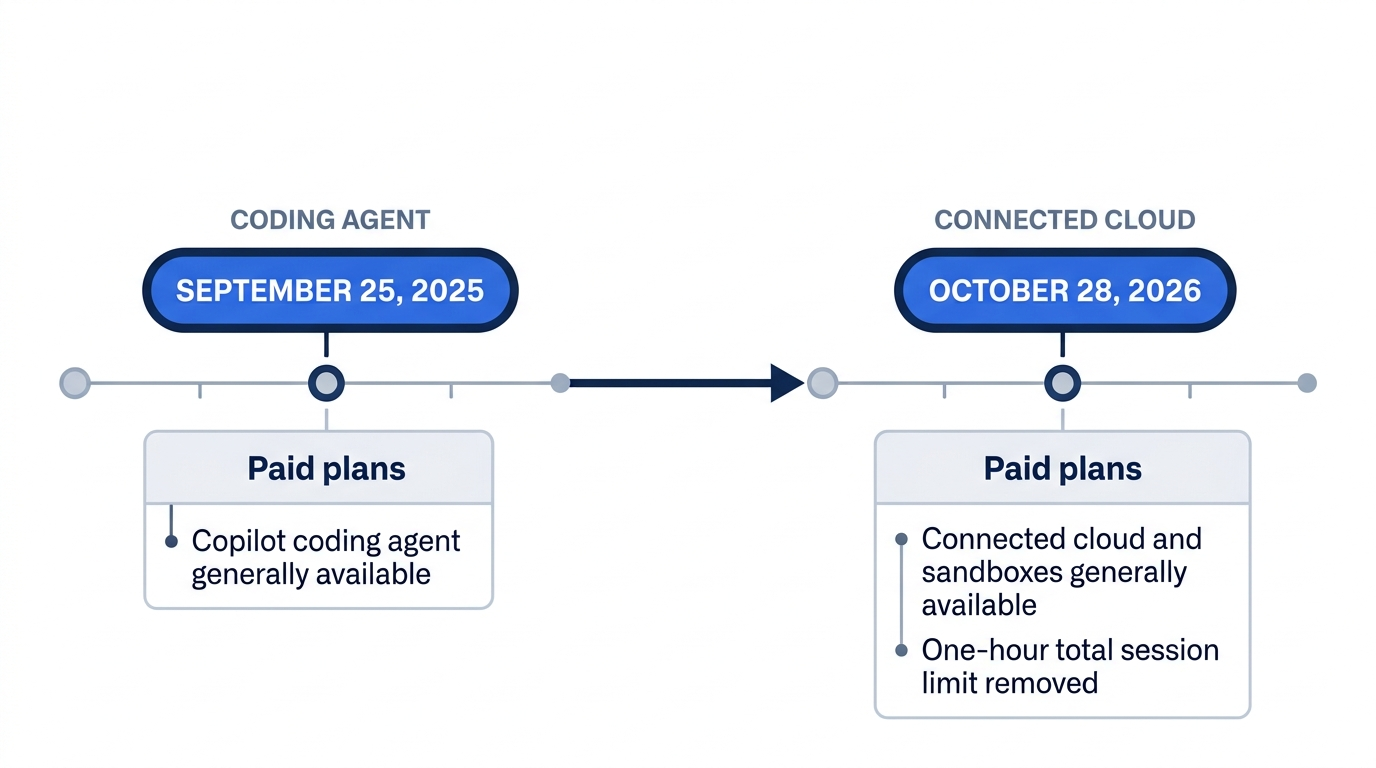
Sandboxes start fast, snapshot on shutdown, and resume later. The October 28, 2026 announcement removes a one-hour total session limit. The older Actions-based agent and the newer cloud-sandbox session are not the same compute lifecycle. Do not reuse an older Actions job timeout as a universal cloud-session limit.
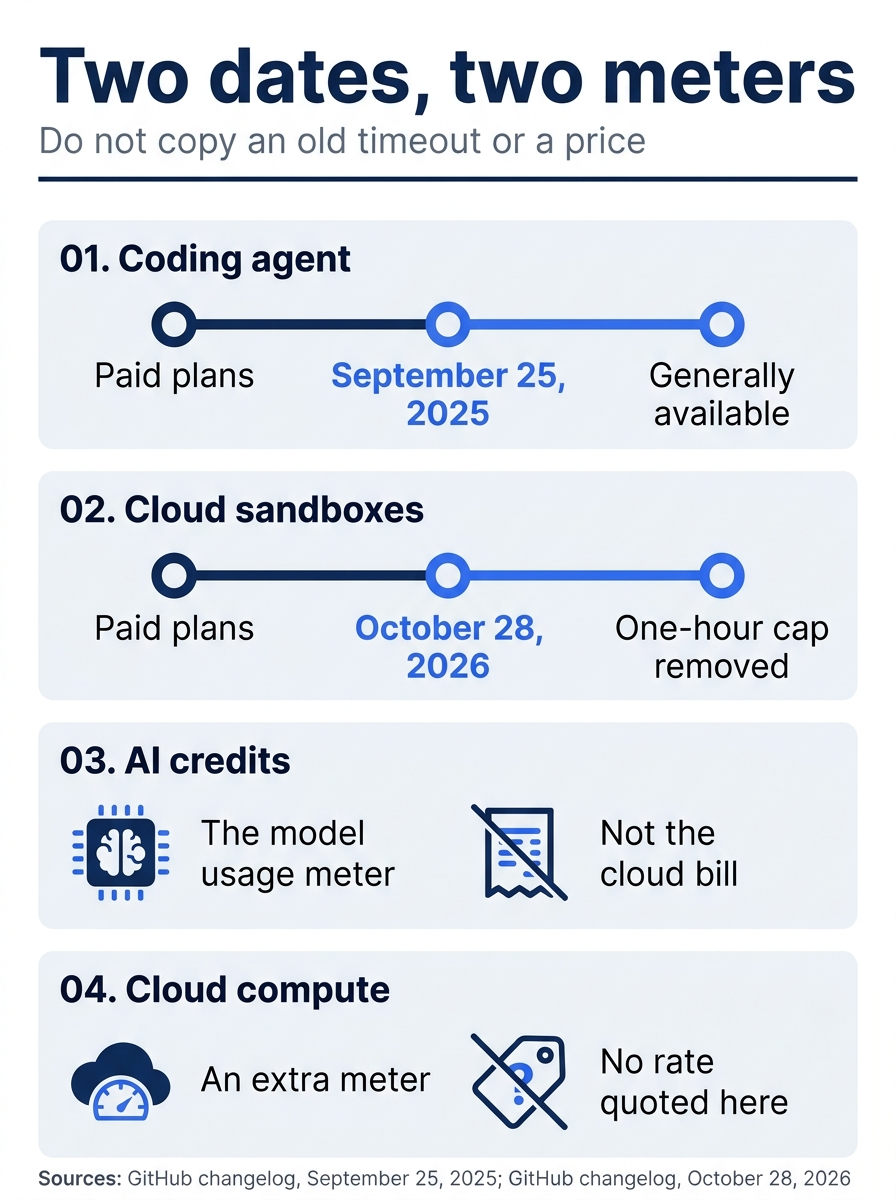
The dates are not interchangeable, and neither are the meters. AI credits measure model use. Cloud compute sits beside that meter. This article quotes no price for a sandbox minute, because the sources do not establish one.
Current sessions can also research and plan. Your prompt still asked for a draft and no auto-merge. You can also start on GitHub, assign eligible work to Copilot, or delegate from a supported client. Do not start a second time in the browser today. A session can move from one supported surface to another.
Confirm your account may use this repository before you assign work. The general skills page still excludes repositories owned by managed user accounts and repositories that are explicitly disabled. A refusal is not a mystery to route around with a token or --yolo.
Inspect the draft and the session log before you accept a result. Accepting is not today's job. Environment setup, secrets, tools, runners, and network access are configured apart from the prompt, and this article adds no setup step. Local delegation and cloud execution are different trust and billing contexts. The branch the cloud agent may edit is not the checkout npm test runs.
What the firewall actually covers
GitHub says that its firewall is on by default, as of November 16, 2026. GitHub and Copilot hosts stay reachable. An enabled recommended dependency allowlist stays reachable too. The allowlist includes common operating-system, language-package, and container registries. The page to use for this scope is the firewall how-to. If another page says that only GitHub and Copilot hostnames are reachable, that line omits the recommended dependency allowlist. Use the firewall page for operational network scope.
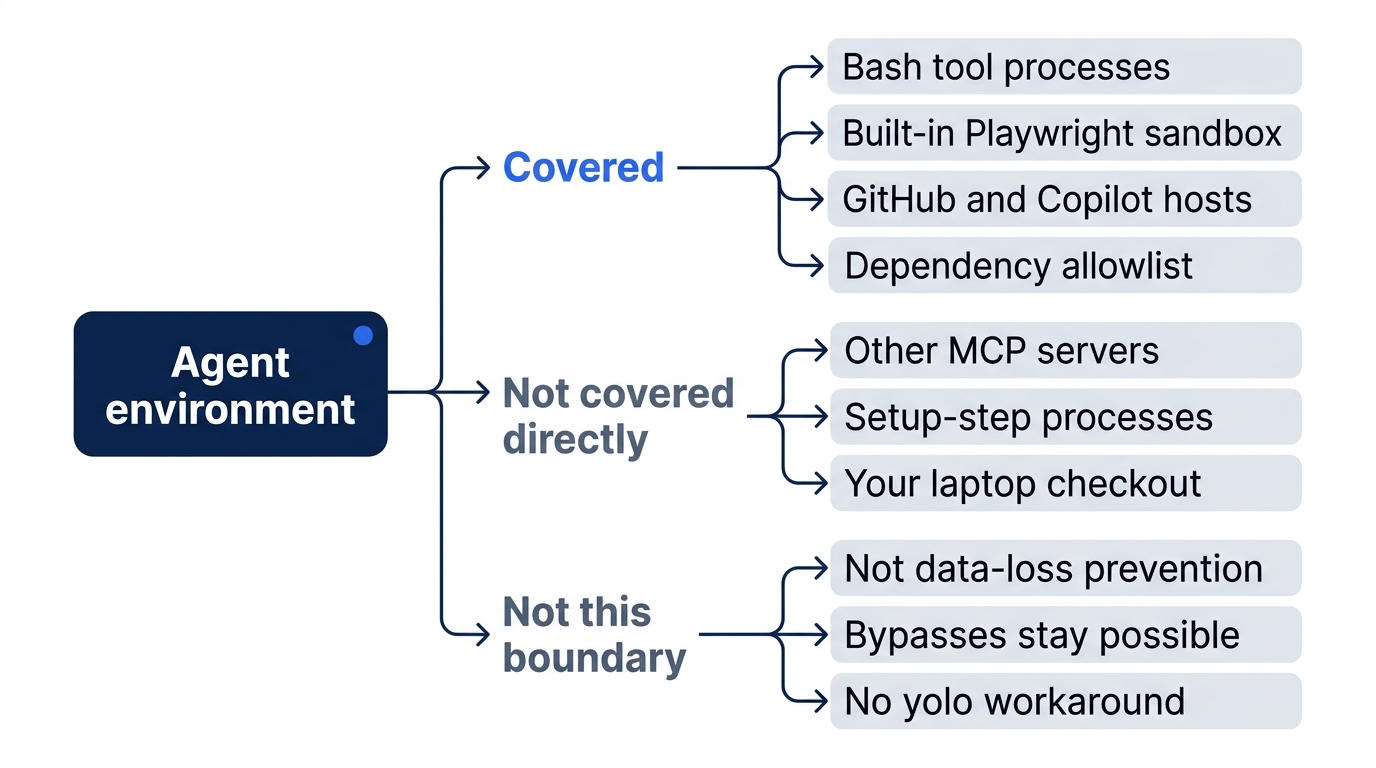
Coverage stays inside the agent environment. The Ticket Triage checkout is outside it. --yolo does not close the gaps.
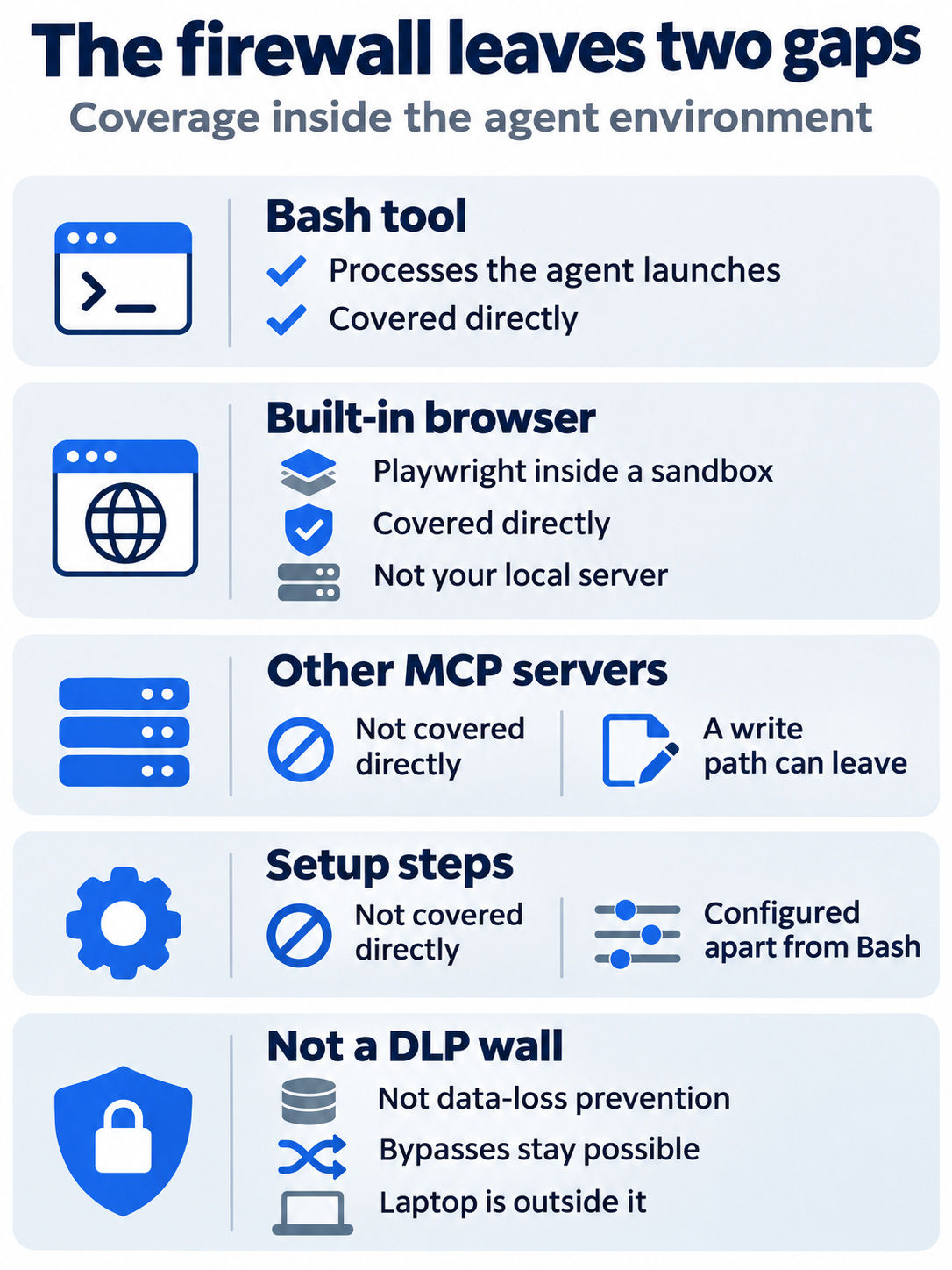
Direct coverage is the Bash tool and, in a cloud sandbox, the built-in Playwright browser. Other MCP servers and setup steps are the gaps. The firewall is not a data-loss-prevention wall that follows you back to the laptop.
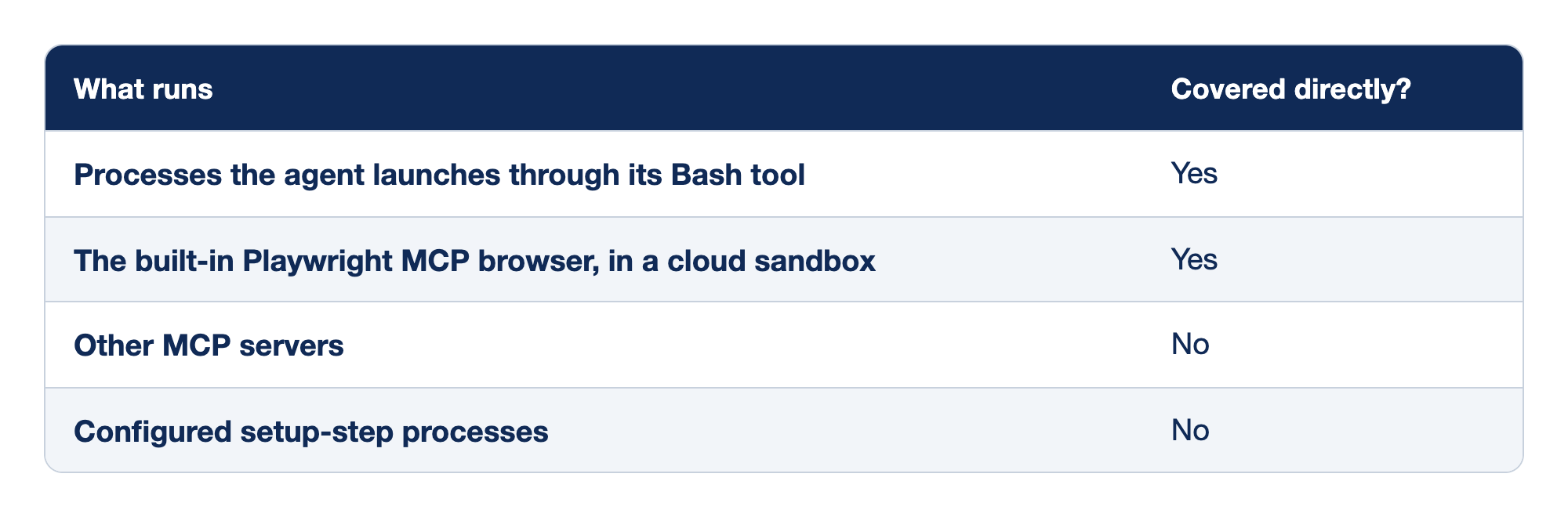
These rows are the coverage the firewall page states for the agent environment, not a list of switches you turn on today, and not a promise about your laptop. The What runs column names the process. The Covered directly? column says whether that page treats the process as inside the firewall.
- Processes the agent launches through its Bash tool are covered directly. The shell commands the agent runs in the environment are the ones this row names.
- The built-in Playwright MCP browser, in a cloud sandbox, is covered directly. A local Playwright server on your machine is not this row. This row is the built-in browser inside the cloud sandbox.
- Other MCP servers are not covered directly. A server that can write to an external system is itself a way out if it was granted that authority.
- Configured setup-step processes are not covered directly. You did not add a setup step today. The gap is still part of the boundary, because setup is configured separately from the Bash tool.
The firewall operates only inside the agent environment. It does not follow you back to ~/code/ticket-triage. Sophisticated attacks may bypass it. Do not call it a data-loss-prevention boundary. You write the gap down. You do not probe it, and you do not "fix" it with --yolo.
Skills stay home, and compute is a second meter
Local home skills are not uploaded automatically. A skill that lives in the repository, under .agents/skills, can travel with the repo. A skill that exists only in ~/.copilot/skills does not travel with the repo. This article did not run a cloud session on November 16, 2026, so do not record that the cloud agent invoked any checklist. Record only where the file lives.
Compute is an extra meter beside AI credits. AI credits are the usage meter for model calls. Cloud compute sits next to that meter. It is not the same number. The sources do not establish one universal cloud-sandbox per-minute price. This article states no dollar rate. If a bill or a settings page on your account shows a rate, that rate is yours to read. It is not a figure that this series can quote as of November 16, 2026.
If you have used Claude Code, handing work to a remote session is a different trust boundary from a local agent.
Do this today
- Write down a draft pull request URL, with auto-merge off and no merge, or a written refusal. You did not pass
--yolo,--allow-all, or--allow-all-tools, and you did not paste a token. There is no sample transcript. Re-run this on your account before you trust the wording. This cloud turn was not run on November 16, 2026. - Do not click Ready for review, do not click Merge, and do not check out the cloud branch. A refusal stops the day.
- Run
git diff -- src/classify.jsandgit status --short. Both print nothing.npm teststill showsrefund,shipping,other, andcrushed mug in pieces is other, plus# tests 4,# pass 4, and# fail 0. An old localotherexpectation is not a failure. - Write the firewall gap in one sentence: Bash-tool processes are covered, and so is the built-in Playwright browser in a cloud sandbox, and other MCP servers and setup-step processes are not. A note that calls the firewall a data-loss-prevention boundary fails the check.
- Write that the October 28, 2026 announcement removes a one-hour total session limit, and that you did not copy an older Actions job timeout as a universal limit. A note that states a dollar rate per sandbox minute fails the check, because the sources do not establish one.
The laptop is the proof
The pull request looks like the finish line. It is not. A draft, or a written refusal, is the cloud side of the day. Your side is the read, the empty diff, and the decision not to merge.
A checkpoint is a local branch for uncommitted work, so you decline it when git status is empty. Home skills stay home unless they live in the repo. The firewall covers the agent's Bash tool and, in a cloud sandbox, the built-in Playwright browser. It does not cover every way out. Compute sits beside AI credits, and this article still quotes no dollar rate. Leave the draft as a draft. The files on the laptop are how you know you did.
This is Part 11 of "GitHub Copilot, Day-to-Day," a 16-part guide to using GitHub Copilot as a daily coding agent.