
Twenty Pull Requests, and a Review Queue That Tripled
Dispatch admits ready work onto a build workflow only inside review, merge, and money limits, and a person still sets priority.
Agent dispatch limits decide which ready work starts, which workflow runs it, and what it may spend.
Agent capacity feels infinite until twenty pull requests land in a review queue that did not grow a single new reviewer. Agent dispatch limits are how you decide what starts before the token bill arrives ahead of the merges.
In this article: Starting every ready ticket moves the pile into review. Dispatch picks a batch, one of four routes, and a budget. People still set priority. A missing limit means stop, not spend.
Twenty agents, twenty pull requests, one week. The review queue triples. Two edits hit one file. One ticket builds on a dependency that has not merged. The token bill beats the merges. The work was fine. The pile moved into review, where it costs more.
Review capacity, merge order, and money are the constraints. A queue cannot create reviewers. Dispatch chooses what starts, on which workflow, and inside which limits. Schedule later orders the steps inside admitted work by reading the same tickets. Dispatch does not call Schedule.
One input, two jobs
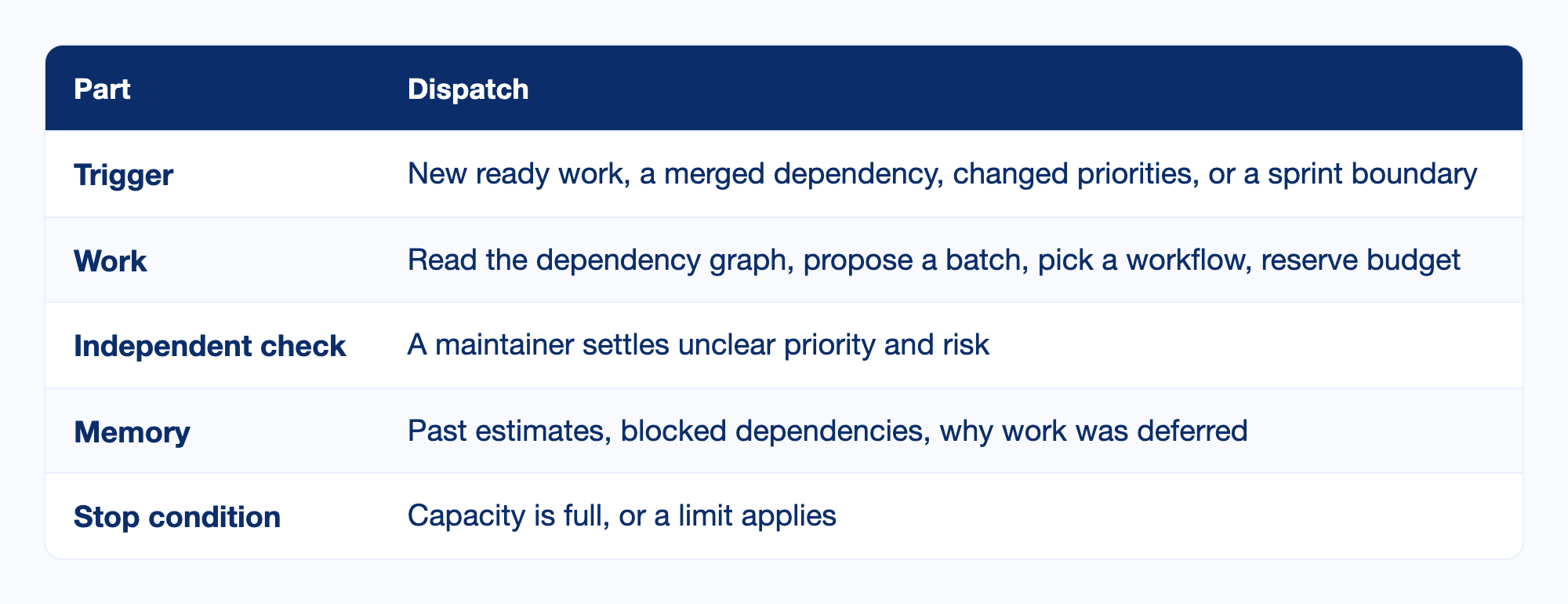
Dispatch's loop has five parts. The Part column names each part, and the Dispatch column says what that part is for this stage.
- Trigger. Dispatch runs on new ready work, a merged dependency, changed priorities, or a sprint boundary.
- Work. It reads the dependency graph, proposes a batch, picks a workflow, and reserves budget.
- Independent check. A maintainer settles unclear priority and risk.
- Memory. It recalls past estimates, blocked dependencies, and why work was deferred.
- Stop condition. It stops when capacity is full, or when a limit applies.
Shrinks for the human: backlog sorting and assignment policing. Grows for the human: priority, handoff limits, and the risk policy.
Selection asks what starts now. Routing asks which workflow and budget. Both read the folded ready tickets and write a decision back. Start Plan and Dispatch as one agent on the same context. Use one agent per stage until a stage clearly does two jobs.
L3 as dispatcher, four routes
A bump, a bug, and a feature need different harnesses, reviewers, and budgets. Dispatch picks.
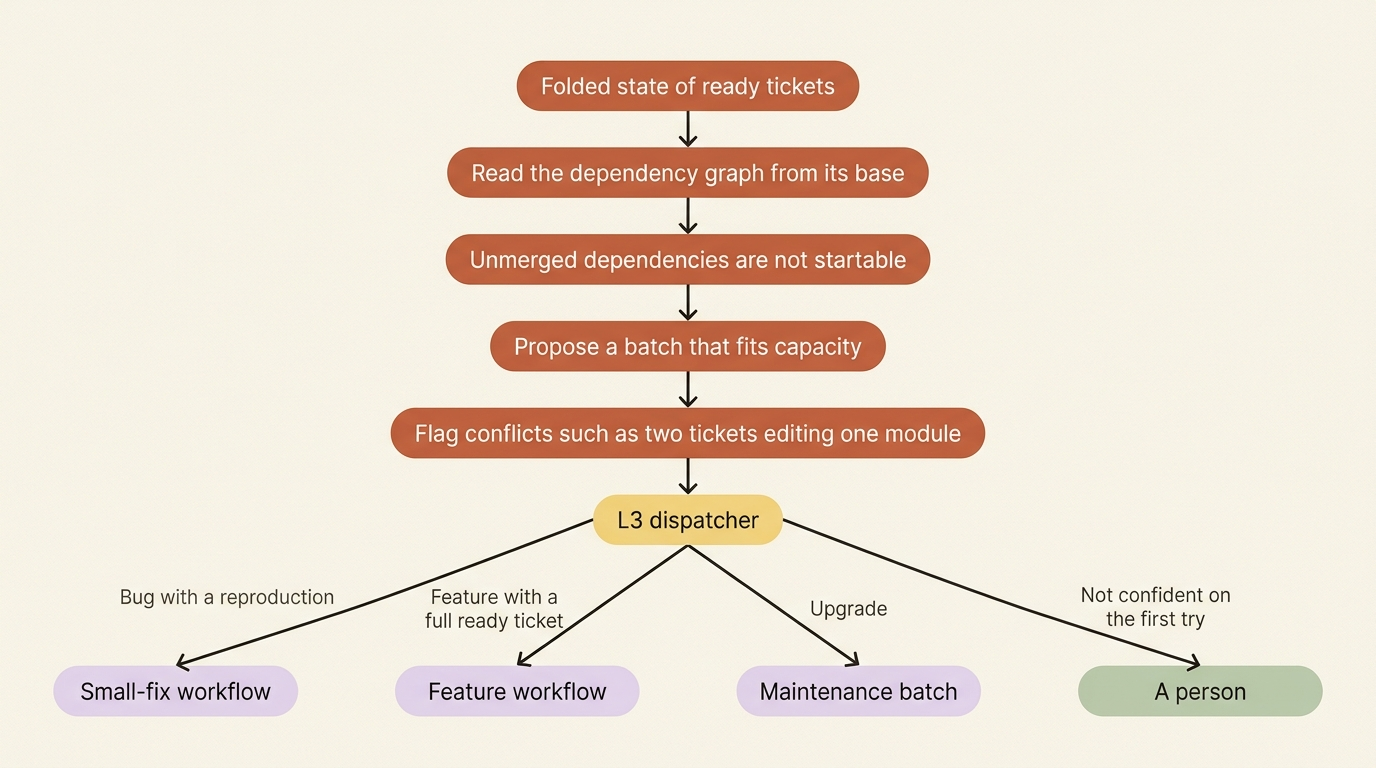
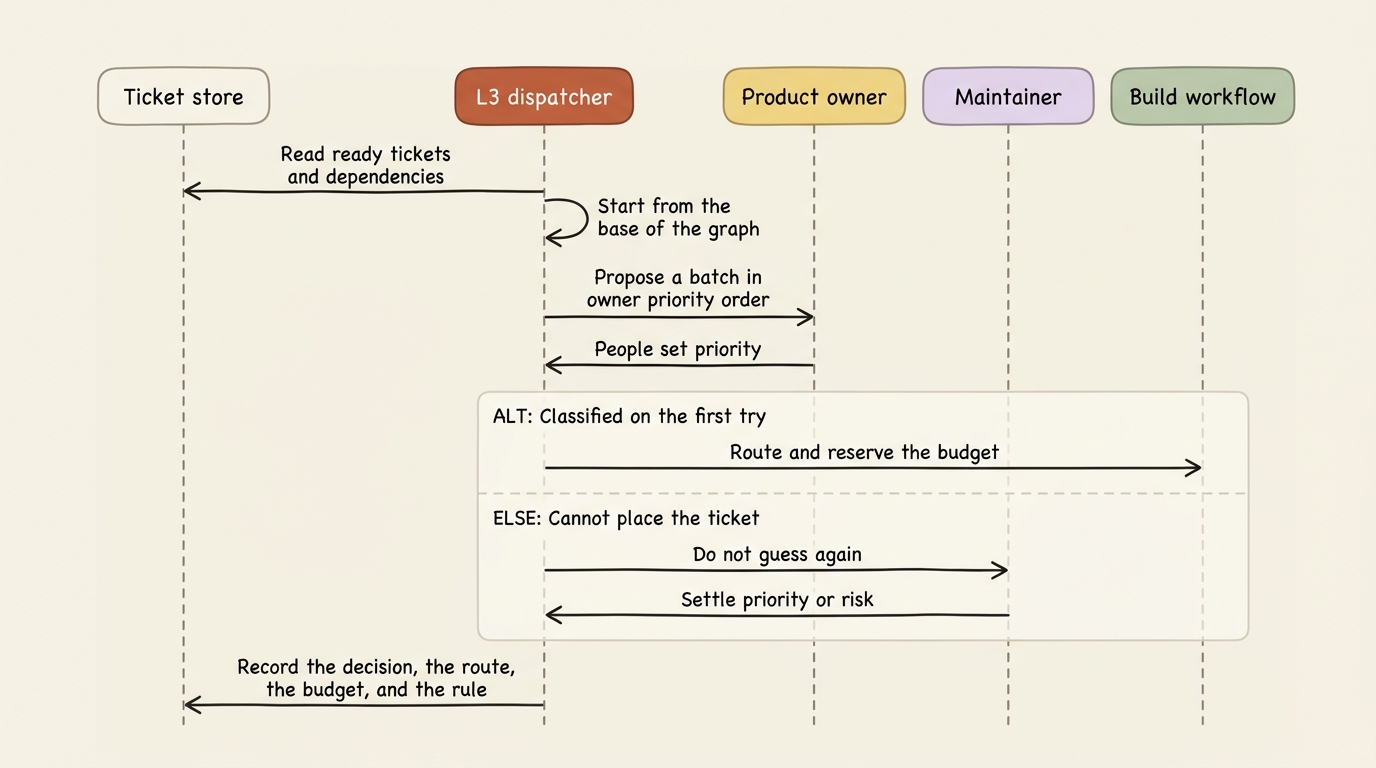
Read the graph from its base. Unmerged dependencies are not startable, at any priority. Propose a batch that fits capacity, in the owner's order, and flag two tickets that would edit one module.
Then route. A reproduced bug uses the small-fix workflow: short time budget, one reviewer. A full ready feature uses the feature workflow. An upgrade joins a maintenance batch. Low confidence goes to a person, on the first failure. Do not guess again. A second guess is how risky work enters the fast lane.
Build the tier from several signals. Sensitive paths in the repo say how much of the system is touched. Verifiability is the second signal. Business impact is the third: money, security, or customer data. Each signal proposes a tier. The highest wins. Set it again on the real diff, because a small ticket can become a large change. Anyone may raise a tier. Only the platform owner may lower one, and the change is logged.
Prefer a ready-ticket event, or a merged dependency, over a timer that spends tokens when nothing changed. Put a stable work ID on every trigger so a retry cannot start the work twice.
Incidents skip this queue. They go to Respond, which holds reserved capacity. The permanent fix comes back later as ordinary ready work.
Limits travel with the handoff
The attachment that matters is the budget, not the priority. Build reads the time and money it may spend. It does not receive new permission from Dispatch.
Pilot settings to tune, not proven optima:
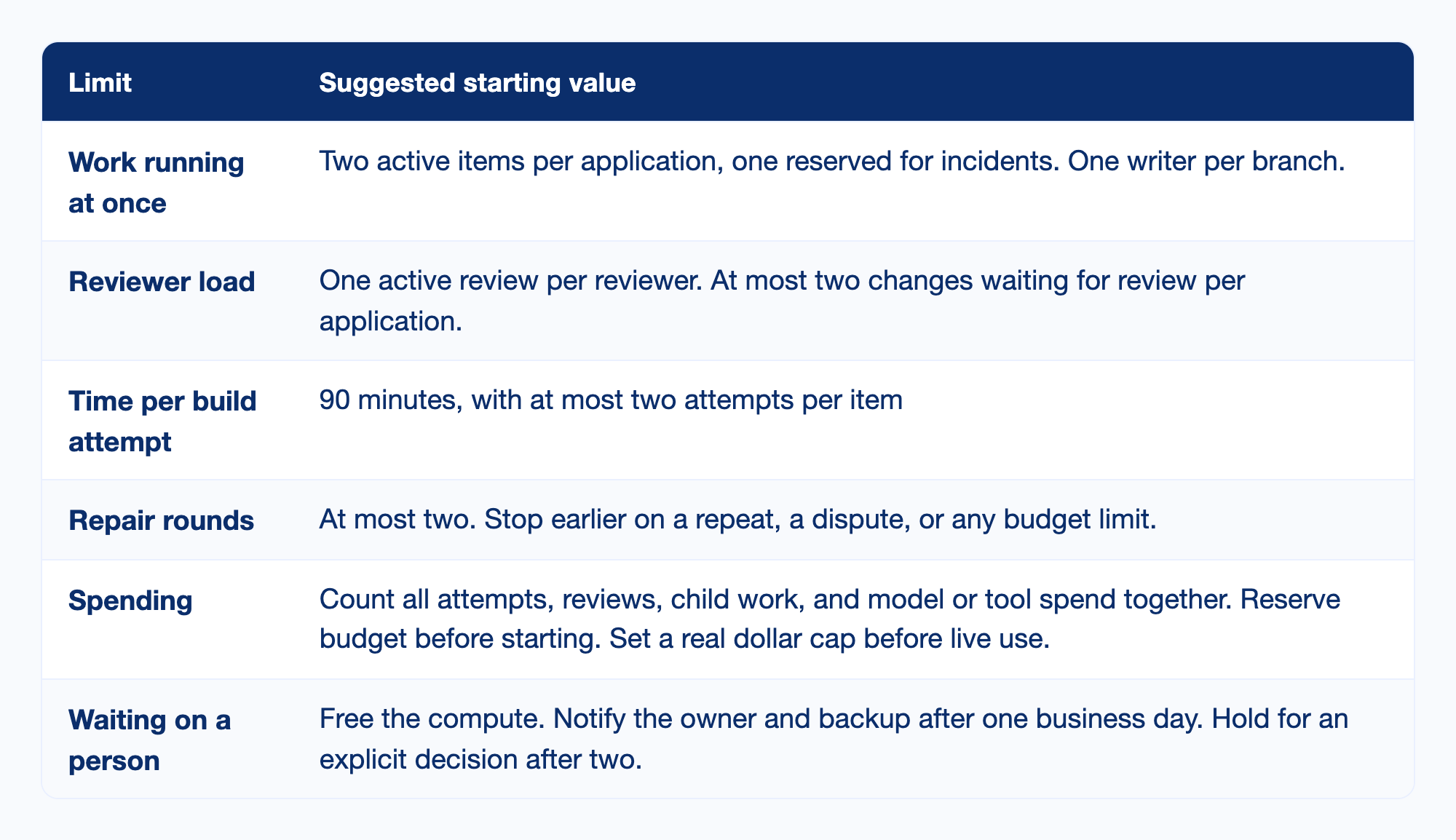
Six limits travel with the handoff. The Limit column names what is capped, and the Suggested starting value column gives a pilot setting to tune, not a proven optimum.
- Work running at once. Allow two active items per application, with one reserved for incidents, and one writer per branch.
- Reviewer load. Give each reviewer one active review, and let at most two changes wait for review per application.
- Time per build attempt. Allow 90 minutes, with at most two attempts per item.
- Repair rounds. Allow at most two, and stop earlier on a repeat, a dispute, or any budget limit.
- Spending. Count all attempts, reviews, child work, and model or tool spend together. Reserve budget before starting, and set a real dollar cap before live use.
- Waiting on a person. Free the compute. Notify the owner and backup after one business day, and hold for an explicit decision after two.
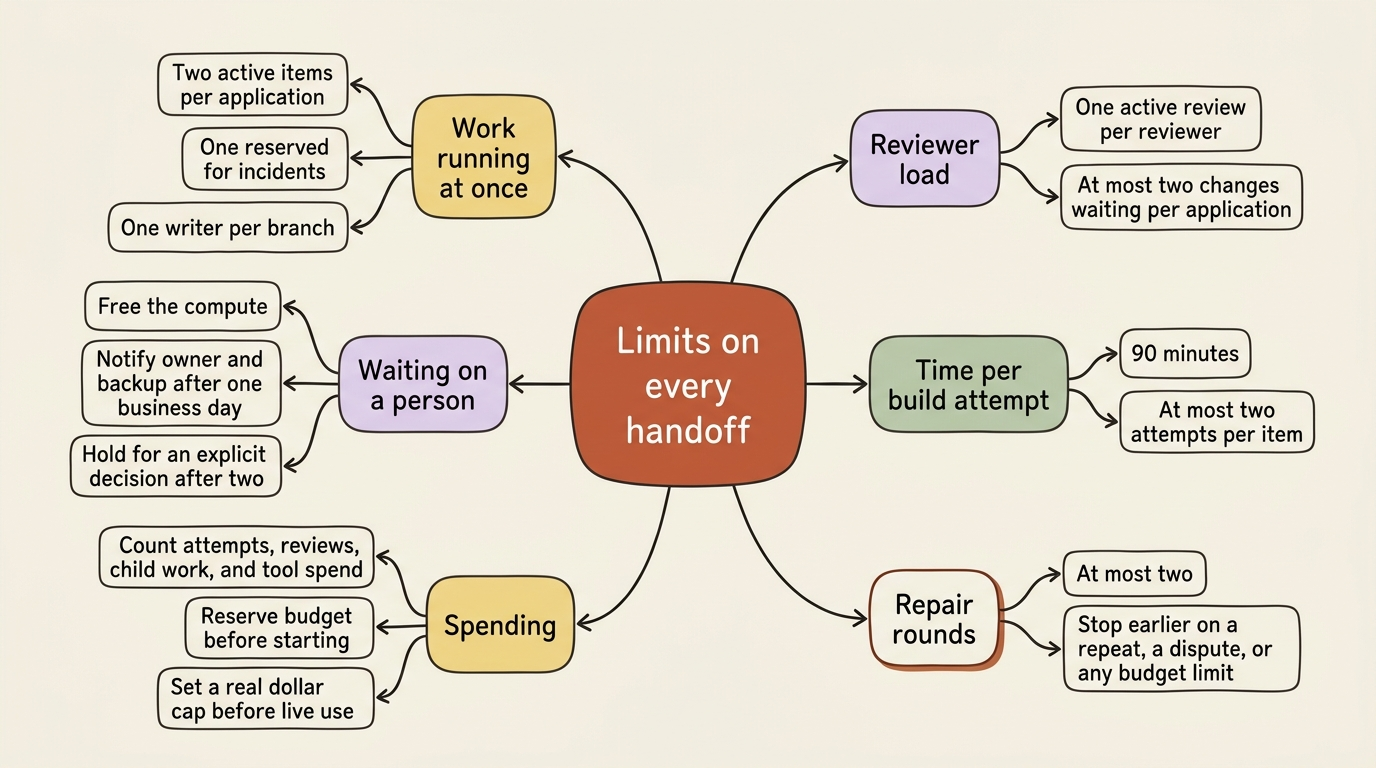
Two waiting reviews per application means a free agent cannot start a third build. It feels slow. It is how the queue stops tripling. Reserve spend before the start so Dispatch can refuse work it cannot afford, and so Build stops when the reservation ends instead of retrying into a bill.
Rules, states, records
People set priority. The agent may rank by dependency, size, and risk. It may not decide that the export ships before the billing fix. A maintainer settles an unclear call.
- A missing limit is not unlimited permission. No budget: stop and ask.
- A handoff transfers information, not permission. The route says what to build. It adds no access.
- Silence never means approval. Waiting is not a yes.
- Repeated messages must not repeat the action. A retried webhook must not start a second build.
- A stop request is not proof of stopped execution. Free the slot only after the workflow confirms it stopped.
The named states are proposed, admitted, running, waiting for evidence, waiting for a person, completed, held, failed, cancel pending, cancelled, superseded, and retired. "Cancel pending" and "waiting for a person" are the ones teams discover during an incident if the contract never named them.
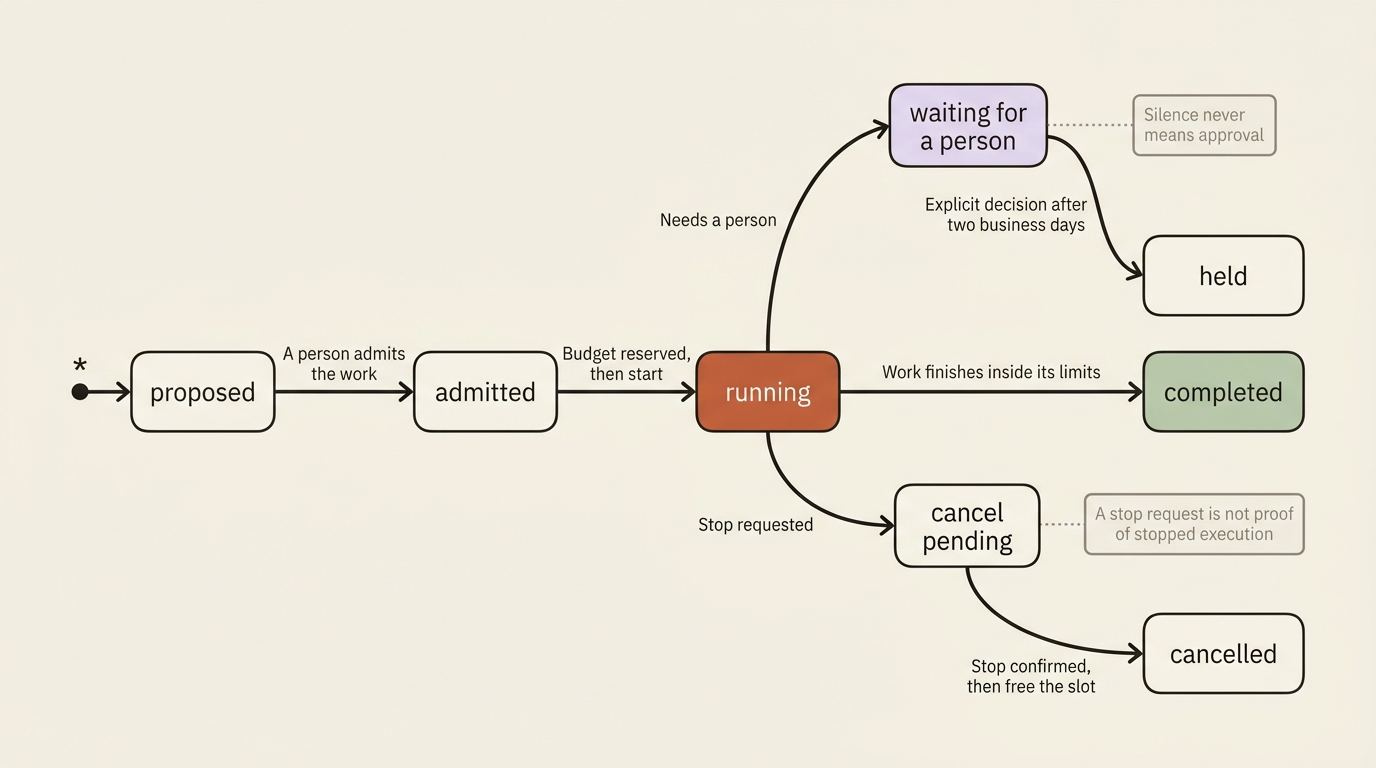
Read and write the same ticket store Plan uses. The record says admitted, which workflow, which budget, which rule, plus holds and deferrals. A replayable queue answers why the billing fix waited three days. WikiTicket is one append-only git log that makes this cheap. Any audited tracker works.
Recall past estimates, blockers, and conflict-prone areas before the batch. After the sprint, record why work waited. "We always underestimate migrations" should enter the next proposal, not die in the hall.
No published case, across several research passes, shows an agent owning production backlog priority. Nearby patterns are deterministic graphs, tracker rules, and a person starting an agent from chat. Multi-agent self-assignment is still "assess" on the Thoughtworks Technology Radar. Leave priority with people. Agents take the graph, the conflicts, the route, and the limits.
Examples you can swap: WikiTicket SDD for state and events; Beads or Claude Code Tasks when admitted work needs an order; tracker routing rules for simple cases; Claude Code scheduled tasks for a daily pass.
Start as a digest. Once a day, rank by dependency and priority, flag conflicts and missing budgets, and let a person pick. Run two weeks. Automate admission only for the class where proposals already match the picks. Disagreement is a rule for shared memory.
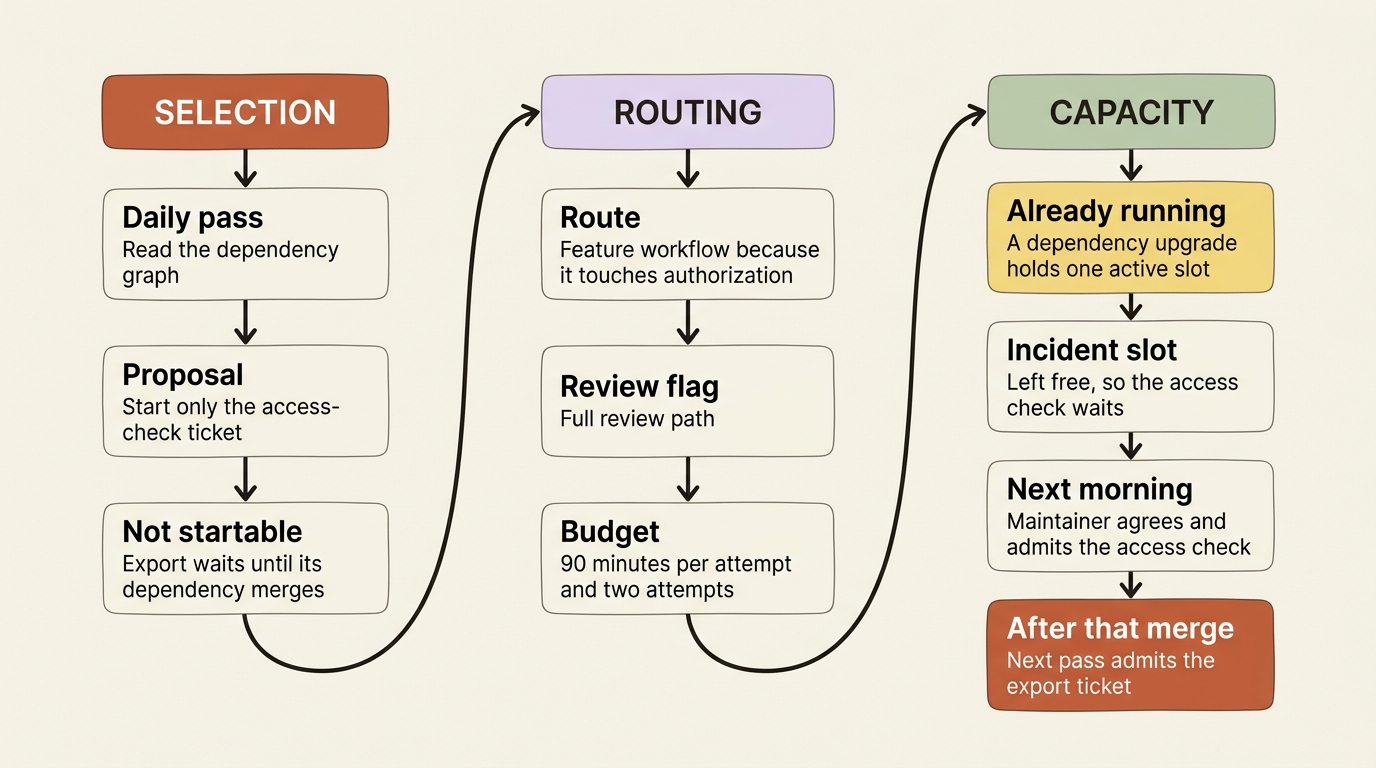
A fictional export waits
Two ready tickets: access checks, then the export that depends on them. The pass starts only the access check. The export is not startable until that merge, at any priority.
Authorization sends it to the feature workflow, on the full review path, at 90 minutes and two attempts. A dependency upgrade already holds the one active slot, so the incident slot stays free and the access check waits. The maintainer admits it the next morning. A few seconds of agent time. No new review-queue depth.
When the checks merge, the next pass can admit the export. Schedule reads that ticket. Dispatch still does not call it.
Further reading
- Ticket Risk Tiers
- Agent Loop Stopping Conditions
- The Retry That Booked Marta's Flight Twice
- Wicked Ticket
- PR Approval Tiers
- Managing a merge queue, GitHub
Do this today
- Cap waiting reviews at two per application. Do not start a build because an agent is free.
- Set a budget before start: 90 minutes, two attempts, two repair rounds, two active items with one incident slot, one writer per branch.
- No budget means stop. Silence is not a yes. A retry must not start the work twice.
- Free a cancelled slot only after the workflow confirms the stop.
- For two weeks, a person picks from a daily digest. Automate only the matches.
What does not start
A full start list looks like speed and arrives as conflicts, a tripled queue, and a bill. Dispatch is the refusal.
The agent may read the graph and propose a route. It may not invent a budget, hear yes in silence, or lower a tier. The useful output is the work left waiting.
Who sets the budget before an agent is allowed to start?
This is Part 4 of "AI Software Factory Series," a 17-part guide to building an AI software factory with human gates.