
AgentCore Harness Versus Bringing Your Own Loop
AgentCore Harness is AWS's managed agent loop, the same 'rent the whole cycle' offer as Anthropic Managed Agents, so the real decision is who owns the loop, not which vendor logo is on the SKU.
AWS sells the managed loop too. The real choice is who owns the cycle, and the judgment that never leaves your plate no matter which path you pick.
You spent a whole series renting the substrate while keeping your own loop, then notice AWS has been selling the full managed loop the whole time. The real choice is who owns the cycle.
In this article: You will reframe the build / rent-the-loop / rent-the-substrate triangle to include AgentCore Harness, AWS's own managed agent loop; see how it lines up with Anthropic Managed Agents; use a four-path ownership table; and apply one heuristic: how much of your value lives in the cycle. By the end you will know when to rent the loop, when to keep it, and why the rubric still belongs to you either way.
The series opened with three ways to get a production harness: build it, rent the loop, or rent the substrate. It spent its main chapters on the third path, and that was the right focus for teams that want a testable reasoning cycle in their own repo.
The triangle was still drawn a little too neatly. AWS has been quietly selling the second corner the whole time.
The fourth corner
AgentCore Harness is AWS's managed agent loop: you configure an agent and invoke it, and the reasoning cycle runs on AWS's side rather than in your process. No @app.entrypoint. No query(). No create_deep_agent. You do not write the loop, because there is no loop in your repo to write.
That should sound familiar. It is structurally the same offer as Anthropic's Managed Agents: define an agent, an environment, and a session; observe a server-side loop through an event stream; configure the harness rather than code it.
"Rent the whole loop" is not one vendor's idea. Two vendors landed there independently, which is strong evidence that the demand is real.
That reframes the decision this series has been making under the surface. The question was never "AWS or Anthropic." It is who owns the loop, and each vendor sells you an answer at more than one price point.
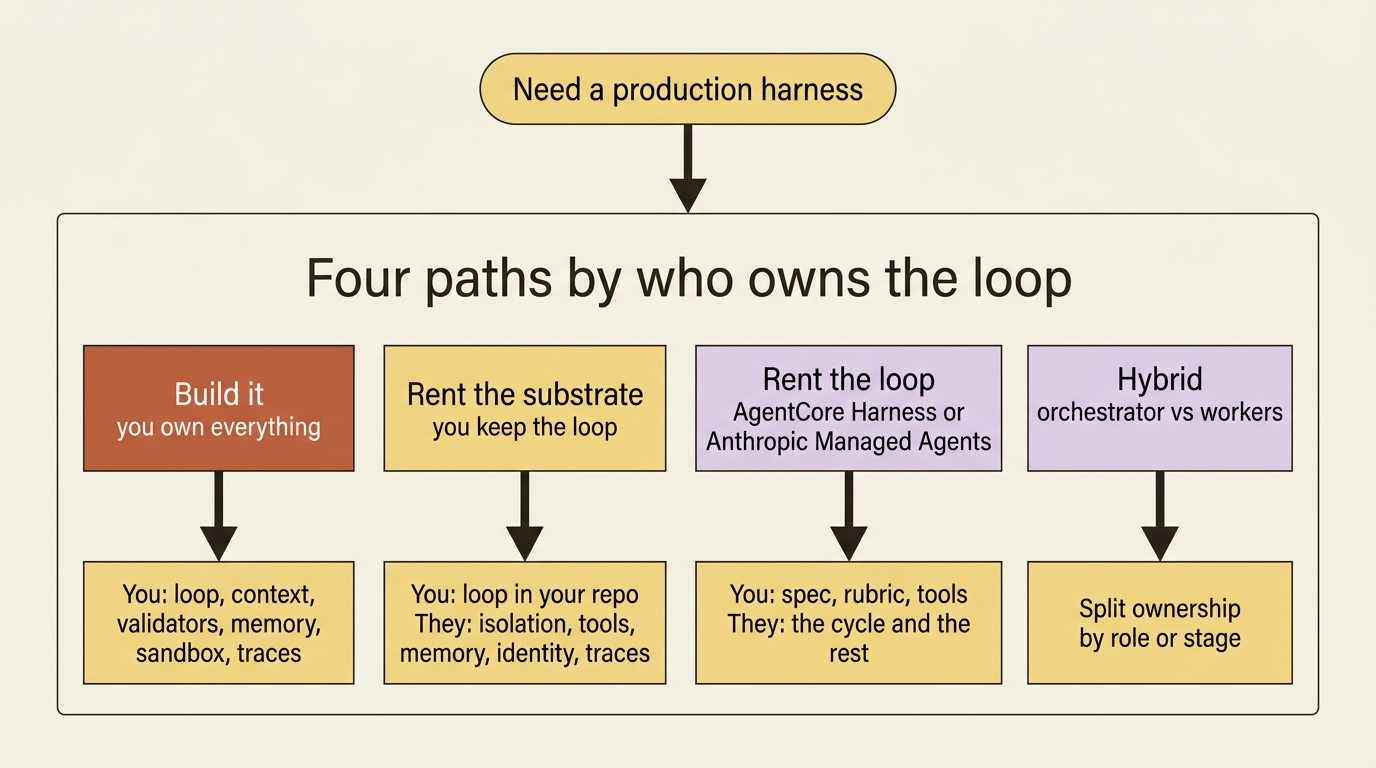
The decision table
| Path | You own | They own | Choose when |
|---|---|---|---|
| Build it | Everything: loop, context manager, validators, memory, sandbox, and traces | Nothing | The harness is your product, or enforcement requirements no policy engine expresses, or cross-cloud portability is contractual |
| Rent the substrate (this series) | The loop, in your framework, in your repo, under your tests | Isolation, hosting, tools, memory, identity, traces, and judges | You want your reasoning cycle testable and versioned, and you want everything around it to be somebody else's pager |
| Rent the loop (AgentCore Harness, Anthropic Managed Agents) | The spec, the rubric, and the tools you expose | The loop, and everything around it | The work is outcome-shaped, and you would rather define what "done" means than maintain a cycle |
| Hybrid | The orchestrator's loop | The workers' loops, or vice versa | Honestly: most large systems, eventually |
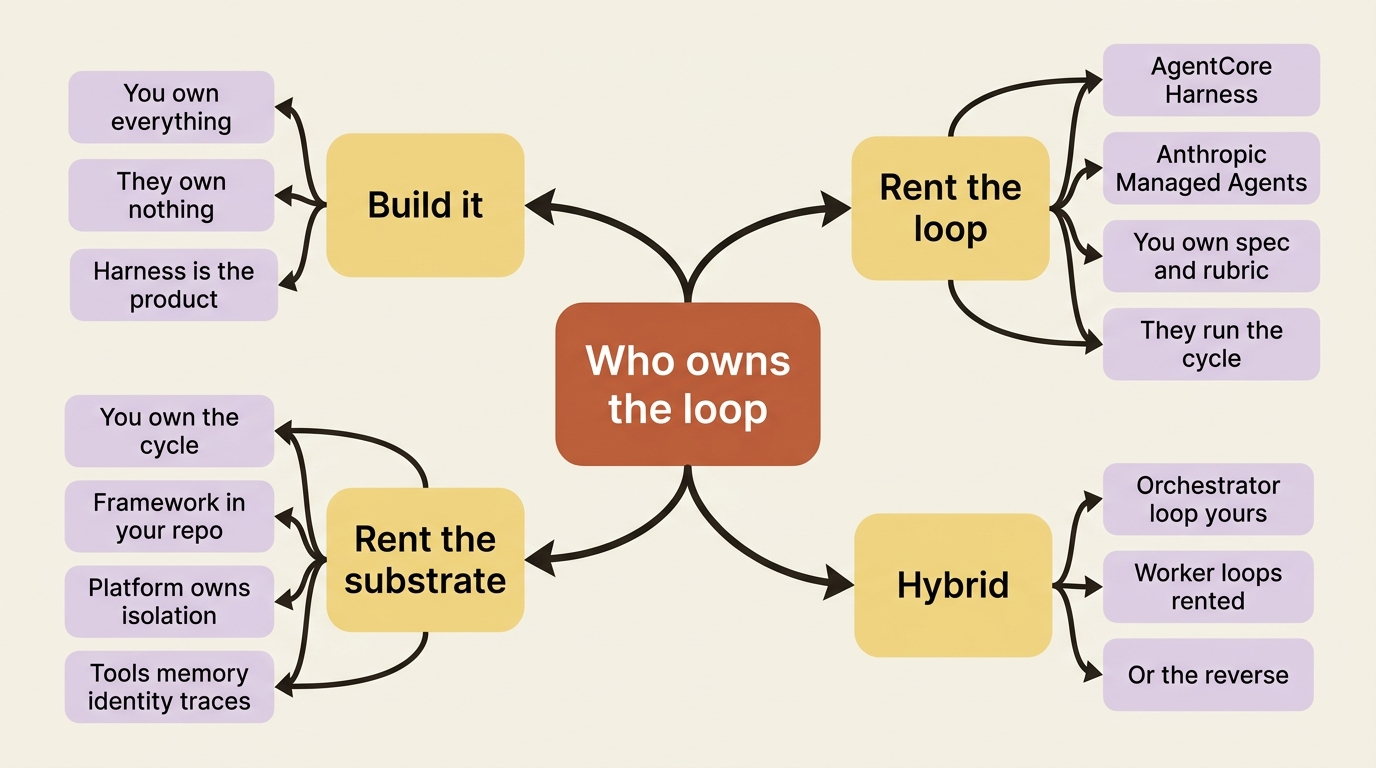
The table is the whole product decision in one grid.
- Build it when the harness is the product, when no policy engine can express your enforcement, or when cross-cloud portability is contractual.
- Rent the substrate when you want the reasoning cycle testable and versioned in your framework, and everything around it on somebody else's pager. That is the path this series maps in depth.
- Rent the loop when the work is outcome-shaped and you would rather define what "done" means than maintain a cycle. AgentCore Harness and Anthropic Managed Agents both live here.
- Hybrid when one answer stops fitting, which is where most large systems land.
The tell
If you take only one heuristic: the choice is about how much of your value is in the cycle.
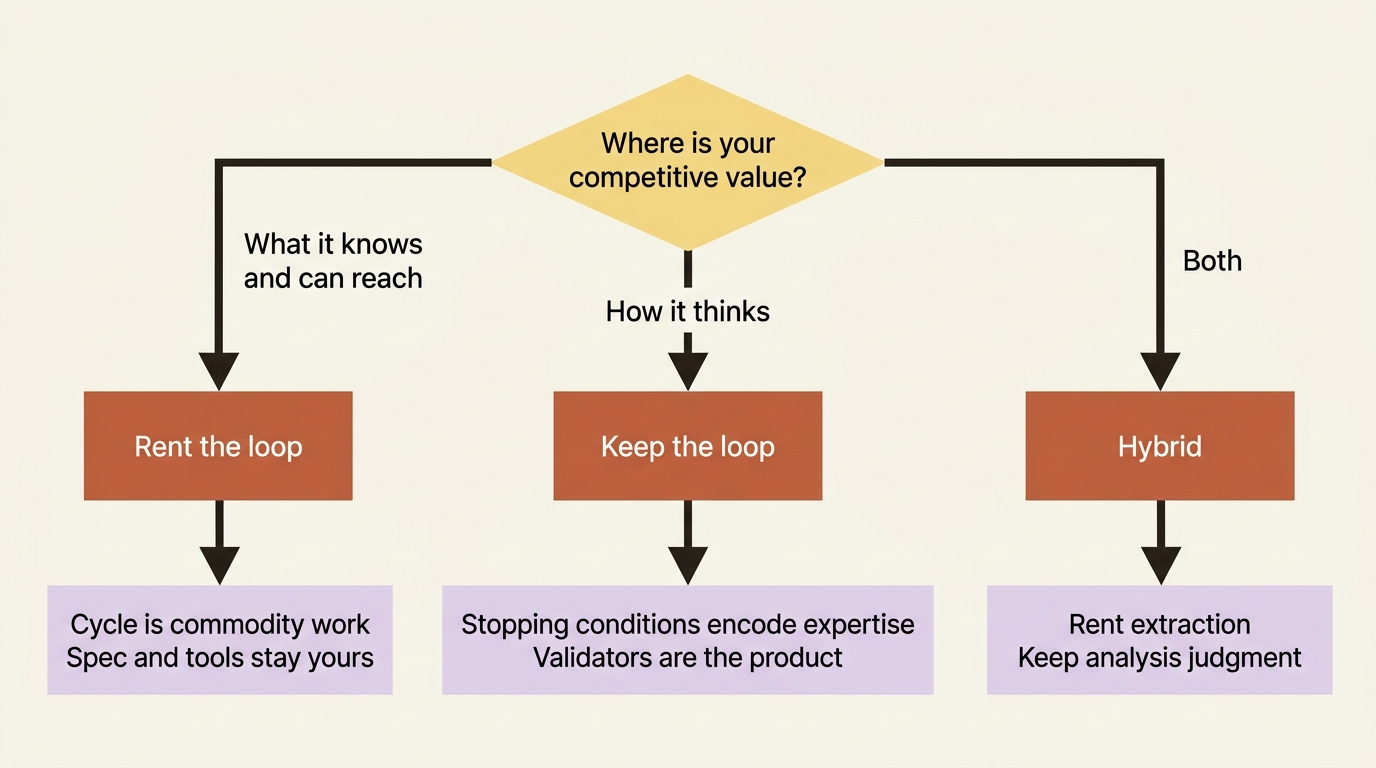
An agent whose differentiation is what it knows and what it can reach wants the loop rented. The cycle is undifferentiated heavy lifting. Maintaining a tool loop only to reach a competitive advantage that lives elsewhere is a tax with no payoff.
An agent whose differentiation is how it thinks wants the loop kept. If your stopping conditions encode domain expertise, if your context manager knows something specific about your data, if your validators are the product, then handing the cycle to a vendor hands away the thing you were selling.
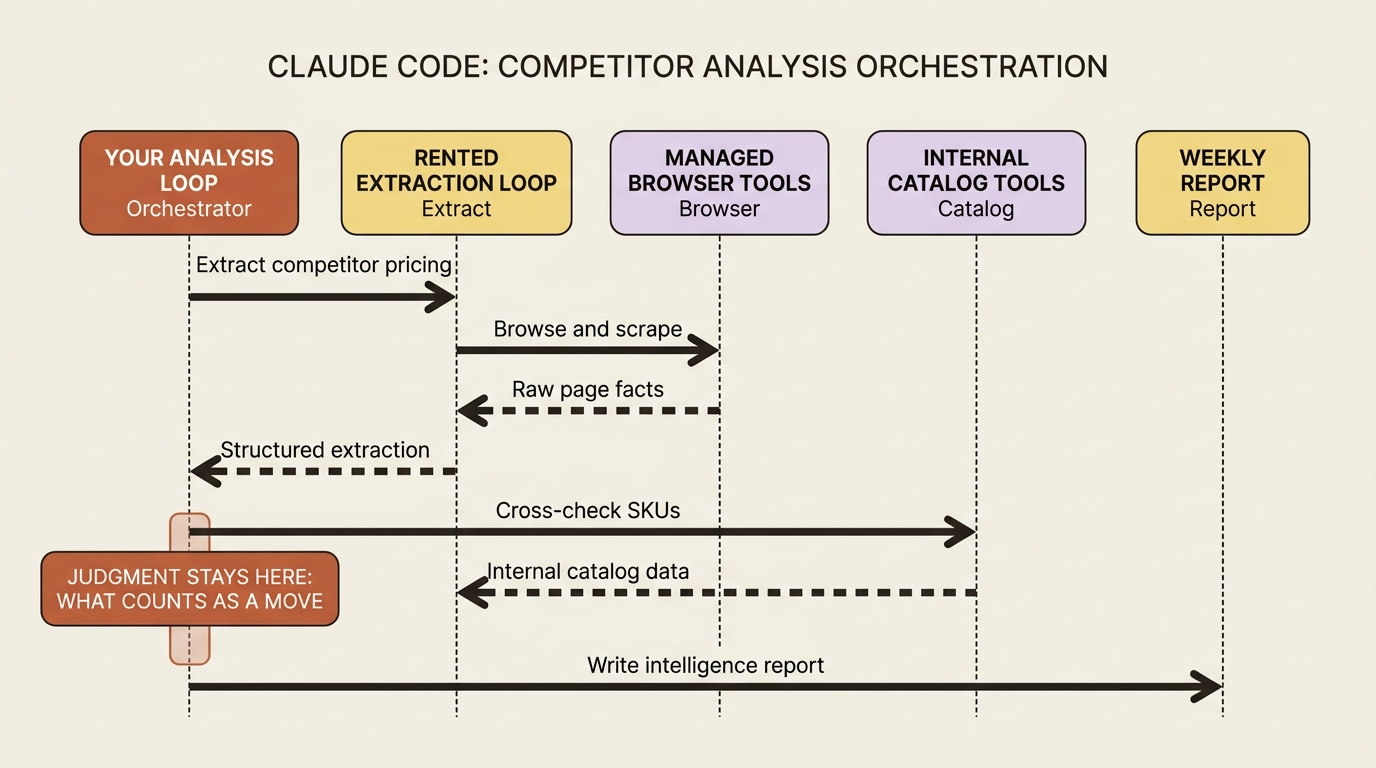
A market-intelligence agent is a good stress test because it is genuinely ambiguous. Browsing and arithmetic are commodities. Judgment about what counts as a meaningful pricing move is not. A defensible version rents the loop for extraction and keeps the loop for analysis. That is the hybrid row, and it is where most of these systems end up.
What does not change
Here is the closing argument, and it is the same one that closes the deploy-and-harden chapter of this series.
Look down the "you own" column on every row. Build it, rent the substrate, rent the loop, hybrid: the residue is the same. Somebody has to know what "done" means. Somebody has to know what "wrong" looks like. Somebody has to assume that the page is lying.
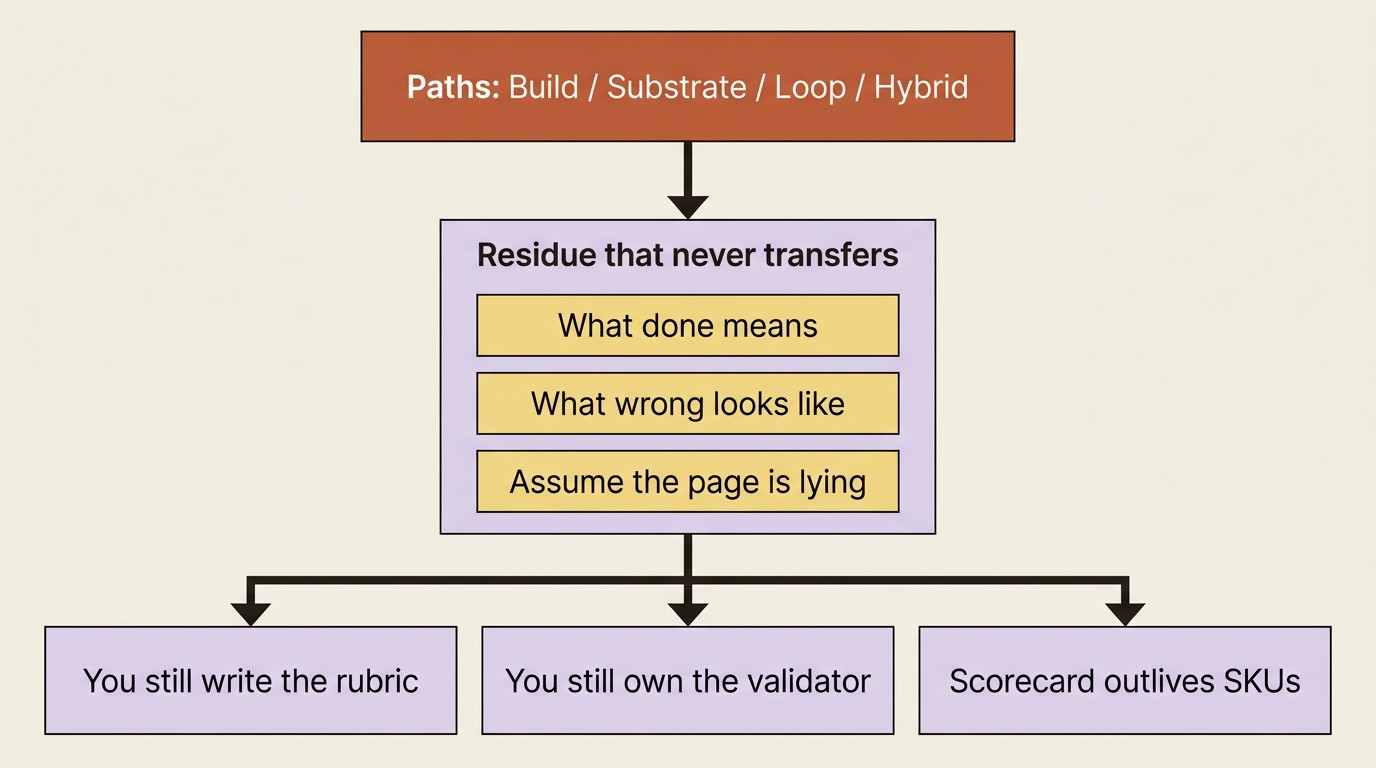
Renting the loop does not remove the rubric. Managed Agents makes you write one explicitly, which is arguably more honest than the substrate path, where you can pretend the stopping condition is just a config value. Renting the substrate does not remove the validator. Building it removes nothing and adds a year.
The four paths differ in how much infrastructure you operate. They do not differ at all in how much judgment you supply.
That is why the scorecard outlives every product claim in this series. Five facts expired in six weeks of research: two toolkits shipped, a store turned out to be first-party, and two services went GA. Every one slotted into the same seven components without changing the shape of the thing. The SKUs turn over quarterly. The question "what is this a managed version of, and what does it still need from me" does not.
Do this today
- Write one sentence naming where your agent's competitive value lives: in the cycle, in the knowledge and tools, or split across stages.
- Map your system onto the four-path table and mark the row you are on today, not the row you wish you were on.
- If you are on rent-the-substrate, list the rubric items you have only implied in code (stopping conditions, "wrong" shapes, untrusted-input assumptions).
- If rent-the-loop looks attractive, draft the outcome rubric you would still have to write before any vendor can run the cycle for you.
- Sketch one hybrid split for a multi-stage job: which stages rent a loop, and which stages keep yours.
Learn the components. Rent the rest.
AgentCore Harness does not invalidate bringing your own loop. It completes the menu. AWS will sell you the substrate under a framework you keep, and it will sell you the loop itself when you would rather write a spec than a cycle. Anthropic sells a peer offer on the managed-loop side. The logos differ. The ownership question does not.
Learn the components. Rent whatever they are selling this month. Write the validator yourself.
This is Appendix C of "Harness Engineering on the AWS AgentCore Hyperscaler," a 12-part guide to building production agents on Amazon Bedrock AgentCore while keeping the loop, the judgment, and the security model yours.