Hiring Alex: The Org Chart When Your Newest Employee Is an AI
Hire your first digital employee. NVIDIA OpenShell + NemoClaw + CrewAI made autonomous AI agents safe to deploy in March 2026. Here is the new org chart.
The future of work has been a slogan for a decade. As of March 2026, it has a runtime.
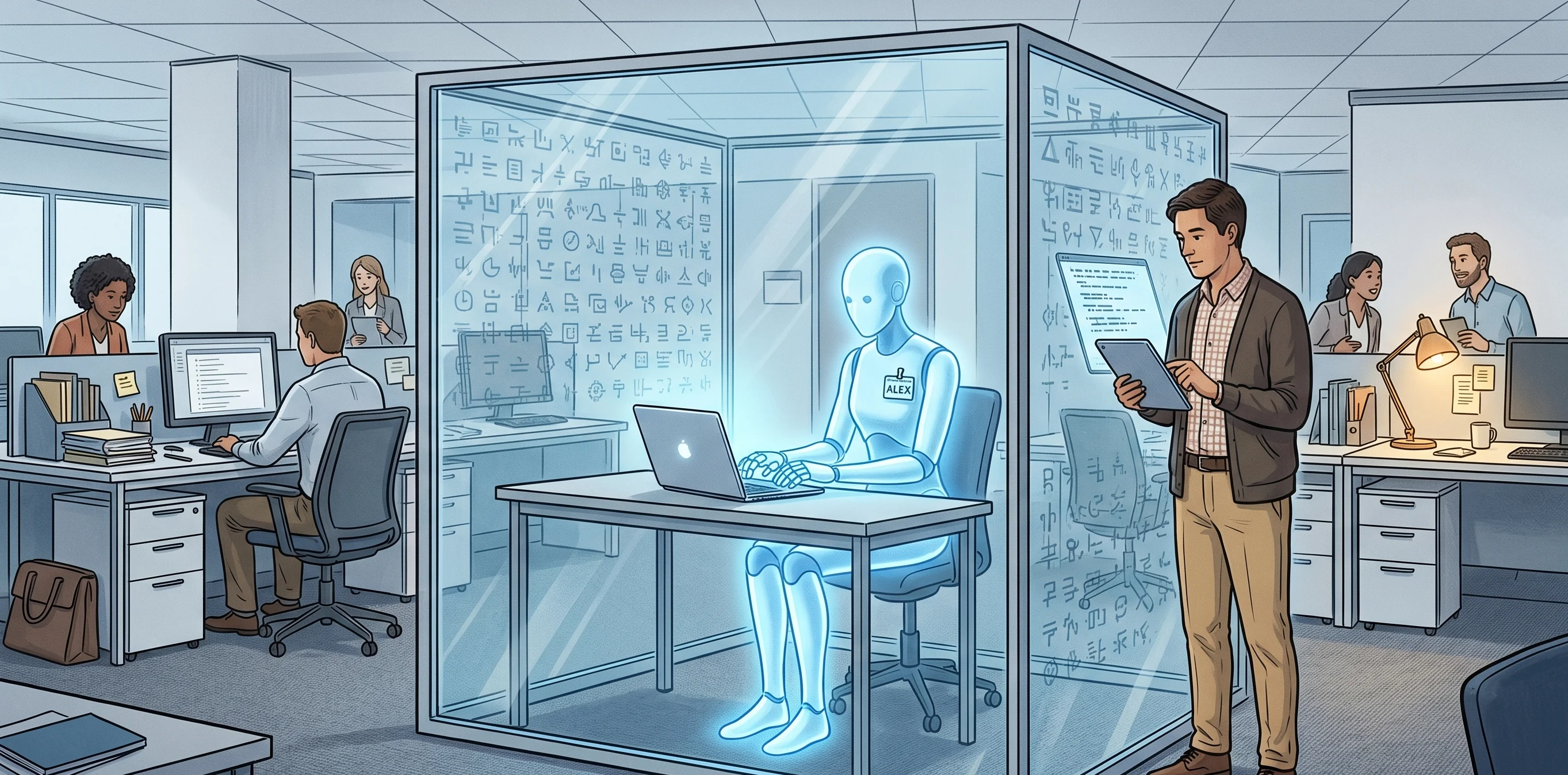
A Monday Morning in 2026
Alex starts Monday.
Alex will not ask for a raise, take vacation, or push back on weekend work. Alex will read every document you forward and never sigh at a recurring meeting. Alex is also brand new, occasionally hallucinates facts, sometimes clicks on things they shouldn't, and has zero concept of what's confidential.
Your only real decision before Alex badges in is the same one you'd make for any new hire. How much of the building do they get keys to?
For two years that question had no good answer. You either gave the agent root and held your breath, or you scoped it down so far that it couldn't do real work. As of March 2026, the middle exists. NVIDIA shipped OpenShell, and in this example we pair it NemoClaw, a hardened fork of OpenClaw slotted in as the worker layer, and the orchestration patterns matured around them. The conditions for hiring Alex stopped being theoretical.
This piece isn't about the runtime. There's an implementer's companion for that. This piece is about what the runtime makes possible. The new org chart, the new management craft, and the question every leader will be asked over the next eighteen months. What does your team look like when half of it doesn't sleep?
The New Org Chart
There's a pattern I've watched repeat in tech for the last two years. The conversation about AI in the workforce keeps getting stuck on the wrong question: will it replace this job, will it replace that one? Replacement is the wrong altitude. The right question is org design.
Every functional team carries two kinds of work. Some is judgment-heavy, ambiguous, relational, and expensive to get wrong. The rest is structured, repetitive, time-sensitive, and expensive only because it eats a senior person's hours. Until now, the options for that second category were outsourcing (slow), brittle automation scripts (limited), or accepting the drag (common). Digital employees add a fourth.
The org chart this produces is not "humans versus agents." It's humans managing small crews of specialized agents, supervising work that used to be a slow drain on every team. That single shift changes hiring decisions, performance reviews, succession planning, and where you'd want a junior person to start their career.
Three things shift at once when this becomes real.
First, the org chart gets denser without getting more expensive. A team that used to be five people becomes five people supervising twenty digital employees, each scoped to one kind of work. Total throughput goes up by a multiple. Headcount budget barely moves. Management overhead changes shape entirely.
Second, the meaning of seniority changes. Junior roles have historically been where you learn the work by doing it. If the rote work moves to digital employees, juniors lose the apprenticeship loop unless companies consciously design a new one. Managers who used to delegate easy tasks down are now delegating them sideways to agents. Where do early-career humans build judgment? That question doesn't answer itself.
Third, management itself becomes a different craft. Supervising a digital employee isn't the same as supervising a human. The performance review is a log review. The disciplinary action is a policy revision. The off-boarding is a scripted teardown. Some of this is easier than human management. Some of it is harder, especially the parts that require explaining to a human colleague what their AI coworker actually did yesterday.
That's the real future-of-work conversation. Not "will AI replace jobs," but "what kind of leader do you have to become to manage a workforce that's half human and half not."
Why We Kept Calling Them "Tools"
This conversation is late, despite the technology being almost ready for two years, because we reached for the wrong metaphor.
We called them "AI tools." Tools are bounded. You give them an input, you get an output, the conversation ends. The blast radius is the scope of the credential they hold. Most of the workplace policies and security models we've inherited were designed with tools in mind, assuming the principal is a human or a service account, and the policy is a list of permitted actions.
Agents don't fit that shape. Agents are processes that decide what to do next. They look at state, form intent, take action, observe results, and revise the plan. That loop is the entire point. It's also why a static permission list cannot bound them. Every credential you give an agent is, functionally, a credential you've given to whatever its next plan turns out to be.
When a CI runner has access to your prod database, your only worry is a buggy build script. When an agent has access to your prod database, your worry is the agent reasoning its way into thinking the right next step is to drop a table. Or, more realistically, following a prompt-injected instruction inside a customer support email and exfiltrating data to an attacker's server.
That risk profile is not a tool risk profile. It's an employee risk profile. Employees can also reason their way into bad calls. The frame we use to manage that risk in human workers is exactly what's been missing for agents: job descriptions, workspaces, supervisors, performance reviews, off-boarding. For two years, the industry tried to bolt employee-style supervision onto tool-style architecture via behavioral guardrails and fine-tuning. A prompt that says "do not exfiltrate customer data" is a request, not a constraint. Anything enforced inside the agent can be subverted inside the agent. That's why the approach kept failing in production. A behavioral guardrail is the new yellow caution tape. It's a request, not a wall.
The Reframe: Treating AI Agents as Digital Employees
Here's the model that does work.
An agent is a digital employee. It has a job description (the system prompt and declared tool inventory). It has a manager (the orchestrator that handed it the task, plus a human). It has access to certain rooms in the building and not others (the runtime sandbox). Its work is logged and reviewable (the audit trail). It can be fired (the kill switch). And critically, when you hire one, you don't hand them the master key on day one. You issue a badge that opens specifically the doors they need, then expand access as trust is earned.
| Employee concept | Agent equivalent |
|---|---|
| Job description | System prompt + declared tool inventory |
| Onboarding | Sandbox provisioning + scoped credentials |
| Workspace | Runtime sandbox (the OpenShell environment) |
| Supervisor | Orchestrator (CrewAI), plus human-in-the-loop gates |
| Performance review | Audit log + behavioral evaluation |
| Disciplinary action | Policy revision |
| Off-boarding | Credential revocation + sandbox teardown |
| HR investigation | Replay of the four-level audit trail |
| Employment contract | The OpenShell policy file |
The last row is the one to memorize. The policy file is not a metaphor for the employment contract. It is the employment contract. It defines what Alex is allowed to touch, where Alex is allowed to go, and what requires manager sign-off. It's more enforceable than any HR document, because it's enforced at the kernel layer, not by social agreement. The runtime makes the contract real.
That's the move that changed everything in March. For two years, policy enforcement lived inside the agent, where a clever input could subvert it. OpenShell moves enforcement outside the agent, to the infrastructure layer. The runtime refuses. The agent has no opportunity to "decide" otherwise.
What Actually Shipped
A short detour to ground this in what's real, then back to the org chart.
The stack that makes Alex possible has three layers. The workplace is NVIDIA OpenShell, an open-source agent runtime released March 16, 2026 that enforces every permission an agent has at the kernel layer, outside the agent itself. The worker is NemoClaw, a security-hardened fork of OpenClaw, the open-source autonomous agent runtime that crossed 247,000 GitHub stars during its first year. The manager is CrewAI, a pattern and library for orchestrating a crew of specialized agents under one orchestrator.
The architectural move that matters is the first one. For two years the industry tried to bound agents from inside the agent: system prompts, fine-tuning, behavioral guardrails. OpenShell moved enforcement to the layer below. The runtime refuses. The agent never gets a chance to "decide" otherwise. NVIDIA frames it as "browser tab security for agents." That captures it well.
That single move is why the Penligent review of NemoClaw landed on a sentence that belongs in every deployment checklist: "NemoClaw can make OpenClaw safer. It cannot make unsafe deployments safe by itself." Hold onto that. We come back to it.
How OpenShell actually pins the filesystem, routes inference, and hot-reloads policy under load is an implementer's question. Those details, plus a working sandbox manifest, live in the implementer's companion to this piece. From here we stay at the org chart.
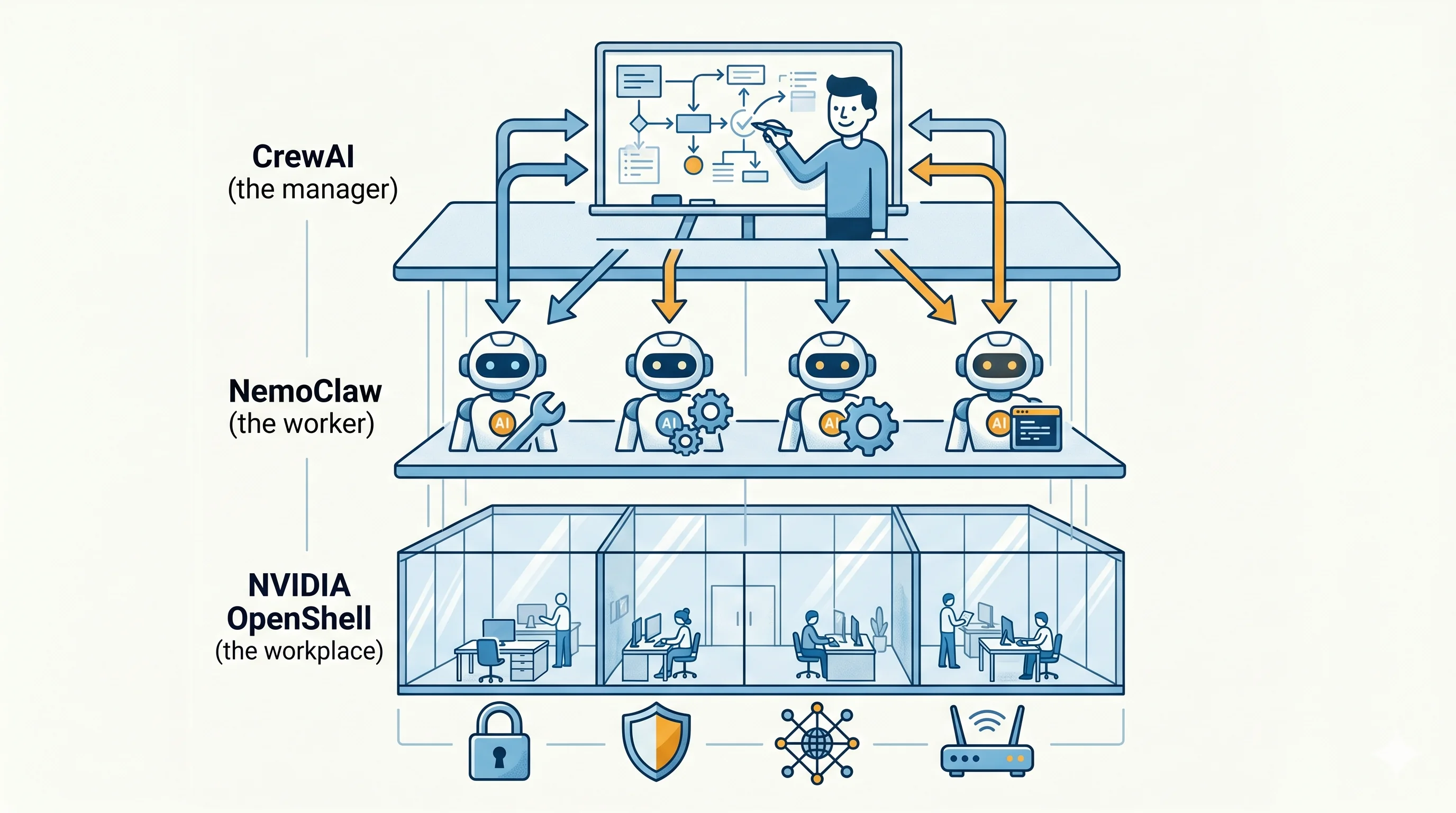
Meet Alex
Abstractions about "AI in the workforce" are why this conversation has been stuck. So here's one specific digital employee.
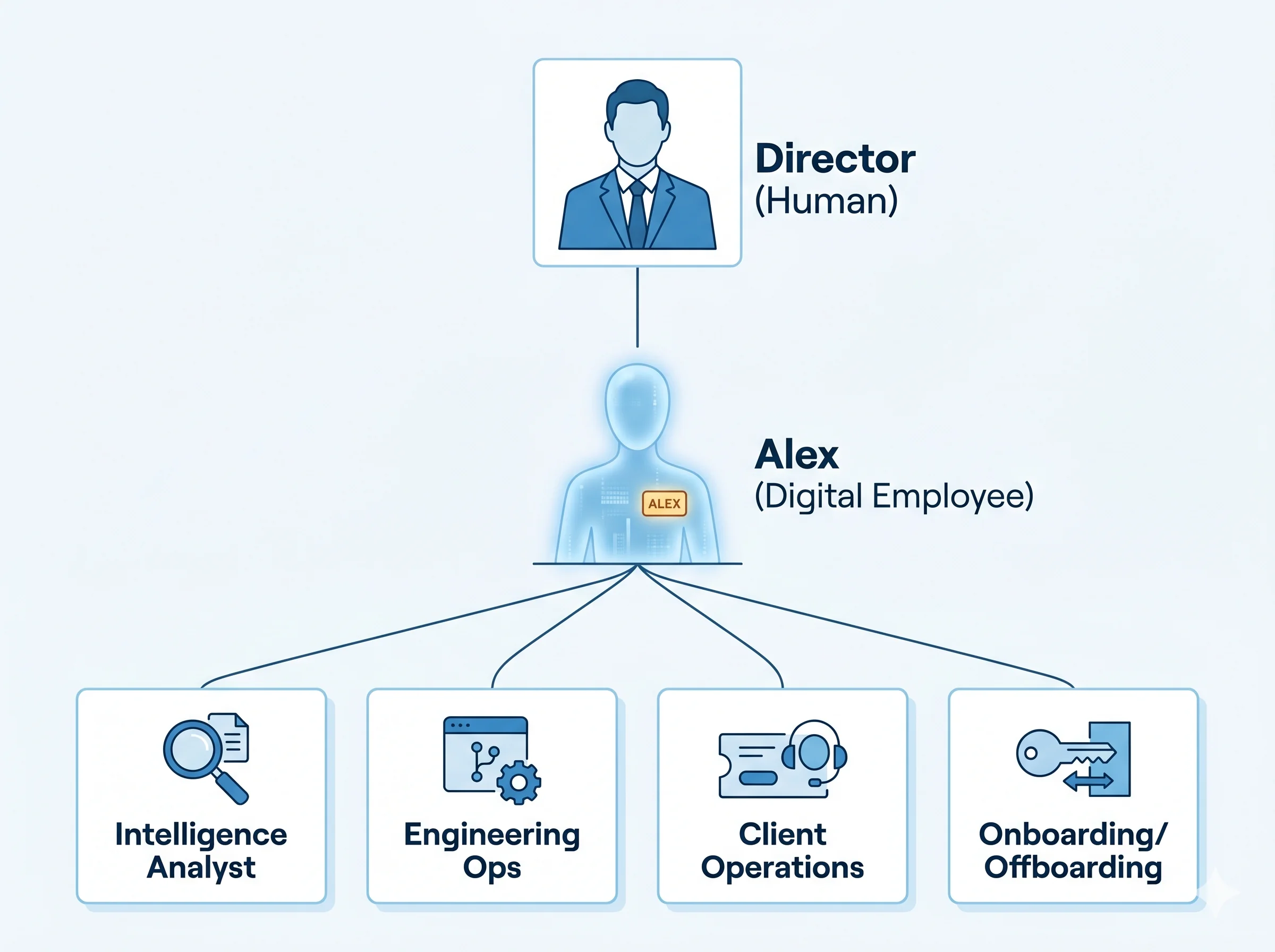
Alex is a Digital Operations Associate at a 10-person consultancy. The same role pattern works for a solo consultant or a 1,000-person company. The crew size scales, the shape doesn't. Alex reports to a human director who reviews their work daily for the first month and weekly thereafter. Alex works around the clock in OpenShell sandboxes on a cloud VM.
Alex is composed of four sub-agents, each scoped to a single area of work, each unable to reach anything outside that scope.
The Intelligence Analyst. Monitors a defined topic surface every morning: competitor moves, relevant GitHub repositories, industry news, regulatory filings, client-vertical signals. Delivers a structured brief by 8am. Read-only outbound access to an allowlist of sources. Filesystem write access scoped to one directory. No credentials. If the entire process were compromised, the worst possible outcome is a misleading brief, which a competent reader will catch before it causes damage.
The Engineering Ops Coordinator. Watches CI/CD pipelines, triages failing tests, flags dependency CVEs, drafts PR descriptions, posts daily standup summaries to Slack. GitHub access scoped to read and comment only, never merge. Slack access scoped to one channel. If compromised, the blast radius is noisy PR comments. Annoying, not catastrophic.
The Client Operations Agent. Monitors project management tools for overdue tasks, drafts status update emails, flags billing discrepancies in time-tracking, prepares weekly client report drafts. Read access to Linear, Jira, and time-tracking tools. Write access only to a drafts folder. No send authority on any channel. The human approval gate in CrewAI is the line between "drafted" and "delivered."
The Onboarding/Offboarding Executor. When triggered by the human director, handles the full workflow for a new contractor. Provisions accounts, sends welcome sequences, schedules intro meetings, populates HR systems. Reverses on departure. Permissions are elevated, but the sandbox is just-in-time. It spawns when the work begins, runs with credentials scoped specifically to the task, completes, logs every action, and is destroyed. Credentials exist for hours, not months. The next onboarding gets a fresh sandbox with fresh scoped credentials. There is no persistent privileged process to compromise.
That last sub-agent is the one that should change how you think about org design. The traditional answer to "automate contractor onboarding" is a long-lived service account with admin rights sitting in an automation server, waiting to be exploited. The OpenShell answer: there is no such service account. The privileges exist only while the work is in progress, and only the sub-agent doing that work can see them.
That isn't a security improvement on the old model. It's a different category of system. The difference between giving a contractor the office key and assigning them an escort for the morning.
The Policy File IS the Employment Contract
This is the conceptual centerpiece, and it'll be obvious in retrospect.
Every employee has a job description, an access scope, approval gates, and a line between what they can do unilaterally and what requires sign-off. For human employees, all of that is scattered across HR systems, IT provisioning workflows, manager intuition, and SOPs nobody reads. Enforcement is social. Boundaries drift. Scope creep is the norm.
For Alex, all of that is one file. Below is the policy fragment for Alex's Onboarding sub-agent. Read it as a job description.
sandbox:
  name: alex-onboarding-executor
  lifetime: jit          # spawn for task, destroy on completion
  identity:
    type: unprivileged
    user: openshell-onboarding

filesystem:
  landlock:
    read:
      - /opt/onboarding-templates/**
    write:
      - /var/log/onboarding/${task_id}/
    deny_default: true

network:
  egress:
    allow:
      - api.identityprovider.example.com
      - graph.microsoft.com
      - api.calendar.example.com
      - hooks.slack.com
    deny_default: true
    hot_reload: true

process:
  seccomp_profile: openshell-default-strict

inference:
  router:
    allow:
      - nemotron-local://onboarding-7b
      - claude-on-prem://nim-endpoint
    deny_default: true

credentials:
  providers:
    - name: identity-provider-token
      scope: ["users.create", "groups.assign"]
      ttl: 4h
    - name: calendar-token
      scope: ["events.create"]
      ttl: 4h

audit:
  log_levels:
    - input
    - retrieval
    - reasoning
    - output
  sink: append-only://siem.example.com/openshell-audit
  immutable: true

approval_gates:
  - on: account_creation
    require: human_approval
    timeout: 30m
That document says: this role can read templates, write only to a per-task log directory, connect only to four named services, run only as an unprivileged identity, send LLM calls only to two approved backends, hold scoped credentials for four hours, log everything at four levels into an append-only sink, and pause for human approval before creating any account.
It's more enforceable than any HR onboarding SOP. The HR document is a request for compliance. This document is compliance, because the kernel will refuse anything outside it.
Three implications follow, and they're the ones that should reshape how you think about management.
Performance management lives in version control. When Alex's role changes, the policy changes. When Alex earns more trust, you widen the egress allowlist or extend the credential TTL. When Alex makes a bad call, the audit log shows you exactly what happened, and you tighten the policy. Every change has an author, a timestamp, a diff, and a review if you require one. The compliance team gets an artifact instead of a meeting.
Disciplinary action becomes a pull request. A human employee who repeatedly triggers an approval gate incorrectly has a conversation with their manager, then perhaps a written warning. A digital employee who does the same gets the gate moved to a stricter mode, by a commit, with a paper trail. The remediation is faster and cleaner. It's also more visible, which creates its own kind of accountability.
Off-boarding takes ten minutes if you wrote the contract on day one. A human employee leaves and off-boarding takes a week of reminders to pull access from a dozen systems. A digital employee gets shut down by destroying its sandboxes, revoking its credential providers, and archiving its audit logs. If you can't do that in ten minutes, the contract was incomplete to begin with.
For HR leaders: the point is not "AI replaces HR." The point is that the parts of HR concerned with defining and enforcing roles get a different toolset. The parts concerned with the human experience of work get harder, not easier, when half your team isn't human.
What You Actually Measure
Skip vanity metrics. Alex is a line item that should produce more value than it costs, and that should show up in the metrics you'd use for any operations function.
For each sub-agent, measure against an honest pre-Alex baseline.
The Intelligence Analyst is measured by hours per week previously spent on manual monitoring (now reclaimed) and by signal quality on the morning brief (sample-and-review, not algorithmic). The harder metric to track, and the most important: how often did the brief surface something that mattered before anyone caught it through other channels?
The Engineering Ops Coordinator is measured by mean time to triage on failing CI runs, mean time from CVE disclosure to team awareness, and PR description quality. These aren't invented for this article. They're metrics every engineering team already tracks. They go up or down depending on whether Alex is doing this part of the job well.
The Client Operations Agent is measured by billing discrepancies caught per month and time to first draft of weekly client reports. The most important diagnostic metric is the rate at which the human approval gate flags an issue with a draft. A high rate means Alex needs more constraints. A near-zero rate after a few weeks means Alex has learned the patterns. That arc is normal and should be expected.
The Onboarding/Offboarding Executor is measured by time-to-provisioned for new hires, time-to-revoked on departure, and credential exposure incidents. That last metric should be zero. If a credential lives outside the just-in-time sandbox window, you have a policy bug, not an operational incident.
Across the whole digital employee, watch one composite metric: policy drift direction. Are your policies tightening over time as you learn what the agent doesn't actually need, or loosening as you grant more access to handle edge cases? Tightening is a sign of a healthy deployment. Loosening should require explicit justification per change, the same discipline you'd apply to scope creep on any human role. With Alex, you can see it in git log.
The metric that belongs at the management layer, not the agent layer, is the one most leaders aren't yet asking for: what fraction of the team's work is now handled by digital employees, and how is that fraction changing month over month? That's the real future-of-work indicator. It's also the one that determines how aggressively your management practice needs to evolve.
What Changes About Being a Manager
The most underrated part of this transition is the management craft. Most discussion about AI in the workforce focuses on the workers, the technology, or the displacement. The thing that changes most in the medium term is what it means to be a manager.
A manager of digital employees does five things differently.
Hires by writing policy, not by interviewing. The hiring process is: draft the role, define the access scope, set the approval gates, configure the audit sink. It takes hours, not weeks. The model selection step (which worker layer, which fork) is closer to procurement than to recruiting.
Reviews work by reading audit logs, not by sitting through status updates. This is faster and more complete than a human check-in, but harder. The audit log is voluminous and not optimized for human attention. Tools to summarize and surface anomalies in agent audit trails are the next frontier of management software, and they barely exist yet. Early-adopter managers are inventing the practice in real time.
Disciplines through configuration, not conversation. When the digital employee makes a bad call, the response is a policy edit, not a one-on-one. This is faster and more permanent. There's no "give them another chance to figure it out." You change the rule, and the rule applies on the next task.
Develops talent through scope expansion, not promotion. The digital employee doesn't move up the ladder. The role gets wider as trust is earned. The crew grows as work expands. That's fine for the digital employee. The harder question is what it means for the human employees on the same team, watching their colleague's scope change in a way that doesn't match anything in the careers playbook.
Spends more time on the human work, not less. This is the part most predictions get wrong. When digital employees absorb the structured work, what remains for humans is harder. More ambiguous, more relational, more dependent on judgment that no policy file covers. Managers who once balanced their time across routine supervision and the hard stuff now spend almost all of it on the hard stuff. That's more rewarding and more exhausting at the same time.
The manager of 2027 isn't managing more humans. They're managing fewer humans, more digital employees, and a higher-altitude portfolio of work. The skill set that scales isn't running meetings. It's designing roles, reading logs, and making judgment calls about the cases that fall outside any role.
The Honest Caveats
Return to the line that belongs in every deployment checklist: "NemoClaw can make OpenClaw safer. It cannot make unsafe deployments safe by itself."
Nothing in this article argues that the technology magically solves the hard parts. I don't claim it does. OpenShell does not fix bad identity design. If you grant Alex's onboarding sub-agent a service account with domain admin permissions, a four-hour credential TTL will not save you. OpenShell does not fix unvetted plugins. Every skill you add is code running inside the sandbox, and the sandbox limits what that code can reach but cannot tell you whether its logic is sound. Misconfigured allowlists, sloppy data classification, audit logs that nobody reads: all operator responsibilities, none solved by the runtime.
The runtime is necessary. It is not sufficient. The teams that win at this are the ones that take both halves of that sentence seriously.
There's a second honest caveat worth naming directly. The vendor and fork landscape is moving fast, and not all of it will land softly. Anthropic blocking Claude subscriptions from third-party agent runtimes in April 2026 is one example of how much business model gravity sits on top of these technical choices. OpenAI hiring OpenClaw's creator is another. The right architectural posture is to assume that any specific worker, model, or runtime you bet on today will need to be swappable within eighteen months. Pluggability isn't a nice-to-have. It's what protects your org's investment in the management practice from being held hostage by a vendor decision you didn't make.
Related Reading
If you're going down this rabbit hole, a few pieces from the archive pair well with this one.
- Agent Framework Wars 2025: Your Strategic Guide to Choosing the Right AI Agent Stack. If you're picking the worker stack underneath your first digital employee, this is the comparison piece. CrewAI is Alex's manager layer; the alternatives are mapped out here.
- Agent RuleZ: A Deterministic Policy Engine for AI Coding Agents. The same "policy is the contract" idea, applied inside the IDE rather than across the org chart. Read it for the smaller-scale version of the same move.
- Claude Code Sub-Agents: Agentic Programming for the Masses?. Where the architectural primitives behind Alex's four-sub-agent crew came from. If you've used sub-agents in Claude Code, you already understand the shape of Alex.
- The $9 Disaster: What Anthropic's Harness Design Paper Teaches Us About Building Autonomous AI Applications. The cautionary tale to read before you hand any digital employee a credential. The runtime story in this article is the answer to the failure modes in that one.
Hire Well, Supervise Well, Off-Board Cleanly
The future of work isn't a slogan anymore.
The conditions for hiring autonomous digital employees in real environments are met. The runtime exists. The worker layer exists. The orchestrator pattern exists. The security argument is grounded in Linux kernel primitives running underneath an unprivileged process that cannot reach across them, not in hope or marketing language. The shape of the resulting org is visible right now, in the small teams running early deployments.
What the next two years require isn't better technology. It's better management practice. The teams that win are not going to have the smartest agents. They're going to have the best workplaces, the cleanest contracts, and the managers who learned the new craft early.
Hire Alex on Monday. Define the role narrowly, scope the credentials, log everything, and expand access only as trust is earned. Watch the audit log. Tighten the policy when it drifts loose. When it's time, off-board cleanly, and hire the next one.
Then look at your org chart and ask which roles you'd rather not be hiring humans for. The answer might surprise you. Not because the agents are smarter, but because the workplaces are finally good enough to trust them.
That's the future of work. It doesn't look like the futurist version. It looks like a Monday morning, a name badge, a glass-walled cubicle, and a manager who knows how to read a log.
And we haven't even talked about the second hire yet. That's a conversation for next time.